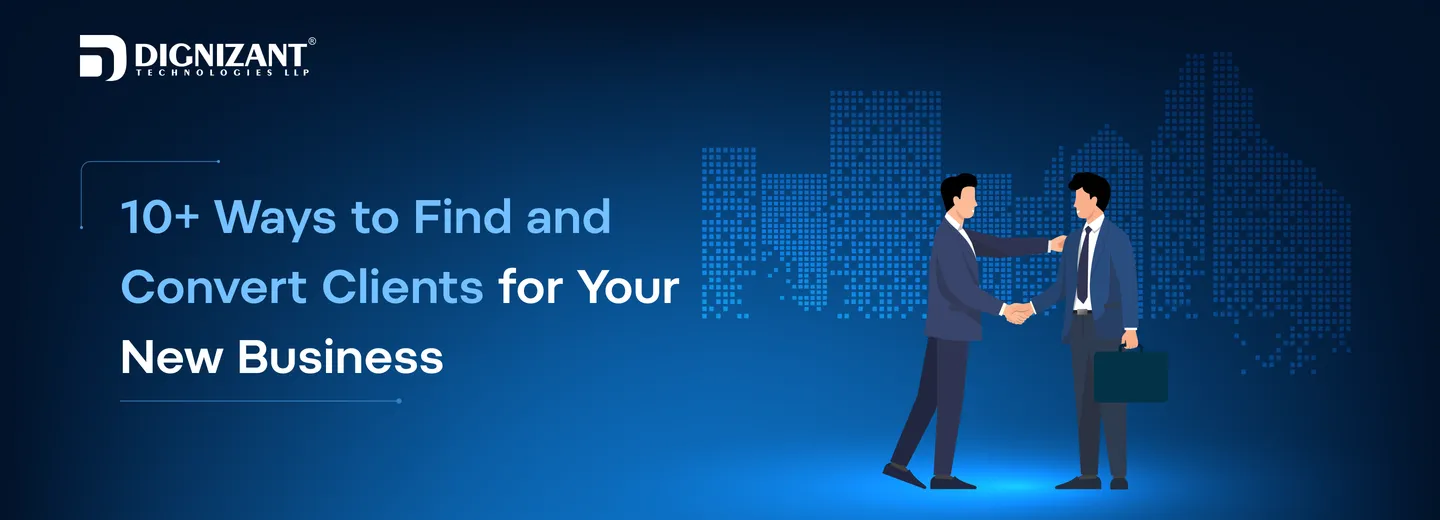
10 Ways to Find and Convert Clients for Your New Business
Contributor
Rutika Sojitra
Uploaded
9 June, 2026
Read Time
11 Minutes
Views
54 views
Starting a new business is exciting. But there is one painful truth every new business owner discovers quickly:
Building something great is only half the battle. Getting clients is the other half, and nobody teaches you how.
You could have the best service, the best team, and the best prices. But if the right people do not know you exist, your business stays invisible. Referrals do not come in. The phone does not ring. And you start wondering what you are doing wrong.
Here is the good news: finding clients is a skill. And like any skill, it can be learned, practiced, and improved over time.
What Does Converting a Client Actually Mean?
Most guides only talk about finding clients. But finding someone is just step one. Converting means turning a stranger into a paying customer, and that requires trust, communication, and the right approach at the right time.
The difference between businesses that grow and those that stay stuck usually comes down to one thing. They do not just find people. They build confidence first. A prospect who trusts you will hire you. A prospect who does not, no matter how good your pitch is, simply will not.
In 2026, with AI tools flooding every inbox and social feed, the businesses winning clients are the ones that feel human, specific, and genuinely helpful. This guide gives you exactly that. Here are 10+ real, proven ways to find your next client and convert them into a long-term relationship.
10+ Ways to Find and Convert Clients for Your New Business
1. Define Your Ideal Client Before You Do Anything Else
Before you go looking for clients, get crystal clear on who you are looking for.
When you try to sell to everyone, you end up selling to no one. A message that speaks to all small businesses is far less powerful than one that speaks directly to fintech startups in India with 10 to 50 employees who are struggling to find a reliable tech partner.
The tighter your target, the stronger your message lands, and the faster you convert leads into clients.
2. Use LinkedIn as Your Primary Client Outreach Tool
LinkedIn is the single most powerful platform for finding B2B clients in 2026, especially for IT, tech, and service businesses.
But most people use it wrong. They set up a profile like a job seeker, connect with people randomly, and send generic pitches. That does not work.
Here is what does work:
Optimize your profile as a service provider. Your headline should say what you do and who you help, not just your job title. A good example would be something like: Helping startups build scalable web and mobile apps.
Connect with the right people. Search for CTOs, founders, operations managers, and project leads in your target industry. Send a connection request with a short, personal note that shows you actually read their profile.
Post content that builds authority. Share short posts about problems your clients face, quick tips, or real results you have delivered. Consistency matters more than perfection here.
3. Ask for Referrals, Starting with Your Very First Client
Referrals are the highest-converting source of new clients. A referred prospect already trusts you before the first conversation. They convert three to five times faster than cold leads and tend to become long-term clients who rarely haggle on price.
Yet most new businesses wait too long to ask. They feel awkward. They think it is too early. They wait for clients to bring it up on their own.
The moment a client says great work or this was exactly what we needed, that is your moment say, "I am really glad it worked out. If you know anyone else who might need something similar, I would really appreciate an introduction."
You can also set up a simple referral incentive. A discount on the next project, a small gift, or a thank-you bonus for any paying client they send your way works well.
4. Cold Approaches That Work
Cold email and cold DMs have a place in 2026, but only if you do them well. It’s not uncommon for a generic template message to be deleted within seconds.
This is the cold outreach formula that converts:
- Research first: Check out their website, LinkedIn, or recent posts before you contact them. Have a specific point of reference to bring up so they know you actually did research.
- Focus on their issue: “Hey, I noticed your company recently expanded its team. Growing IT firms often find it difficult to keep up with client demand at this stage.”
- Keep it short: No more than five lines. No company background, no list of services.
- With one easily answerable question: Do you think a quick 15-min call would be worth it to find out if we can help?
- Follow up: The bulk of responses come off the second or third email. People tend to quit after one. Don’t be one of them.
Good Days to Contact: Day of the Week Tuesday (best), Wednesday, Thursday. Steer clear of Monday mornings and Friday afternoons as the pace of replies slows on these days.
5. Build a Website That Converts, Not Just Impresses
Your website is your 24/7 salesperson. But most business websites focus on looking good rather than converting visitors into actual clients.
Here is what a high-converting website needs:
A clear headline on the homepage that immediately answers three questions: What do you do? Who do you help? What result do they get? A strong example: "We build secure, scalable web and software solutions for startups that need to move fast without breaking things."
Social proof above the fold. Client logos, testimonials, or a short case study result give visitors a reason to trust you in the first few seconds before they scroll anywhere else.
One strong CTA. Not five buttons pointing to different pages. One primary action such as "Book a Free Call" or "Get a Free Quote." Make it obvious and repeat it two to three times down the page.
Mobile-first and fast-loading. Over 60% of B2B research now happens on mobile devices. If your site is slow or hard to read on a phone, you are losing potential clients before they even read a single word.
6. Provide a Free Consultation or Audit.
One of the quickest routes to turning a skeptical lead into a paying customer is to show them your value before they spend anything.
That free 30-minute consultation call builds more trust than any brochure, proposal or sales page could. In the call, concentrate 100 per cent on their case. Inquire smart questions, listen actively, and hand over two or three truly valuable insights that they can walk away with whether or not they hire you.
For IT and tech companies, a "Free Technical Audit" or "Free Project Scoping Call" is quite popular. You stroll in as a vendor and out as a trusted advisor.
The only rule that matters most here: provide genuine value, not a sales pitch dressed up like advice. Sophisticated purchasers know within the first two minutes. When you really help them in the free session, hiring you for the rest of the project is just the logical next step.
7. Publish Content That Builds Trust at Scale
Content marketing is not about going viral. It is about becoming the most helpful, credible voice in your niche so that when a prospect is finally ready to hire someone, your name is the first one that comes to mind.
For IT and service businesses, the best content formats are:
1. Case studies:
Something like "How we helped a Surat-based startup reduce development costs by 40% in three months" is far more powerful than any generic claim. Real results, real numbers, real impact. You can see how strong project storytelling looks by browsing real client work and outcomes. That kind of proof converts better than any sales copy.
2. Problem-focused blog posts:
Write about the exact problems your ideal clients search for. A post titled "Why IT companies in India struggle to get international clients" speaks directly to a real pain point. That is exactly how you rank on Google and start appearing in AI-generated answers.
3. LinkedIn posts:
Short, specific observations from your daily work perform very well. An honest post that starts with "We onboarded a new client last week and the first thing they said was" builds more trust than a polished company announcement ever will.
Publish consistently. One useful post or article per week beats a burst of ten posts followed by two months of silence.
8. Partner with Complementary Businesses
Some of the warmest and fastest-converting leads you will ever get come not from cold outreach, but from referral partnerships with businesses that already serve your ideal clients.
The logic is simple. Find businesses that work with the same audience you want to reach but do not compete with you directly. Then build a mutual referral relationship where you send relevant clients to each other.
For IT companies, the natural partners include:
- A mobile app development company paired with a product design studio where clients need both services
- A web development firm paired with a digital marketing agency
- An AI or automation company paired with a business consultant
Reach out to these businesses, explain the potential for mutual benefit, and propose a simple referral agreement. You send them clients who need their service. They send you clients who need yours. Warm referrals from trusted partners convert far faster than anything else on this list.
9. List Your Business on Platforms Where Clients Are Already Searching
Your potential clients are actively searching for services like yours right now. The question is whether they can find you or not.
Make sure you are listed, and listed well, on the platforms they actually use:
1. Google Business Profile:
Free, powerful, and underused by most IT companies. A properly set-up Google listing means you show up when someone nearby searches "IT company in Surat" or "app development near me."
2. Clutch.co and GoodFirms:
The go-to directories for IT and software companies. Enterprise clients and startup founders visit these sites specifically when evaluating vendors. A strong profile with real reviews generates consistent inbound leads over time.
3. LinkedIn Company Page:
This is where decision-makers go to vet a business before they ever reach out quietly. Keep it current and professional.
4. Upwork or Toptal:
If you are open to contract work, these platforms bring clients directly to you. Use them strategically in the early stages to build case studies and testimonials fast.
Keep every profile updated with fresh portfolio work, client reviews, and a clear description of what you do. You can see how a clean, well-structured service profile looks by checking how Dignizant presents its AI and machine learning capabilities with clear outcomes and easy contact options.
10. Show Up in Communities Where Your Clients Spend Time
People hire people they know and trust. One of the most natural ways to build that trust without a big marketing budget is to show up consistently in the communities your ideal clients already call home.
Online communities like LinkedIn groups, Slack spaces for startup founders, Reddit forums such as entrepreneur and startups, and niche Facebook groups for business owners are worth your time. Join to contribute, not to sell. Answer questions honestly. Share real experiences from your own work. Over time, people notice who adds value, and they reach out on their own.
Offline events like local startup meetups, industry conferences, and chamber of commerce gatherings still produce some of the strongest client relationships around. One real conversation at the right event can lead to a six-month engagement.
The rule is the same everywhere: be helpful first. Pitching immediately reads as desperate. Being consistently helpful reads as expert.
11. Collect and Show Social Proof at Every Stage
In 2026, clients do not just take your word for it. Before they ever contact you, they have already checked your reviews, browsed your past work, read a testimonial or two, and possibly Googled your company name.
Social proof, meaning testimonials, case studies, client logos, and ratings, is one of the most powerful conversion tools you have. Most new businesses dramatically underuse it.
Start collecting it from day one:
- After every project, ask for a written or short video testimonial
- Document your results in real numbers where possible, like "reduced cost by 30%" or "delivered in three weeks instead of six"
- Ask satisfied clients to leave a review on Google or Clutch
- Add logos of the companies you have worked with to your website homepage
Even if you are just starting, you can build early proof through personal projects, freelance work at a discounted rate, or detailed write-ups of anything you have built. The goal is to show evidence, not just make claims.
The Follow-Up Is Where Most Deals Actually Close
Here is a stat that surprises most people: 80% of sales happen between the fifth and twelfth follow-up. And most businesses give up after one or two attempts.
Not because they are bad at sales. Following up just feels uncomfortable. It feels like you are bothering someone.
You are not. Your email genuinely got buried. They meant to reply. Life got in the way. A thoughtful follow-up a few days later is professional, not pushy.
Build a simple system and stick to it:
- Day 1: Send your proposal or first message
- Day 3: A short, friendly check-in to make sure it arrived
- Day 7: Add something useful, a case study, a relevant tip, or a quick insight specific to their situation
- Day 14: A final message that closes the loop without pressure, something like: "Happy to reconnect whenever the timing is right. Feel free to reach out anytime."
Use a basic CRM or even a simple spreadsheet to track who you have reached out to and when. Without a system, leads fall through the cracks, not because you do not care, but because you are busy.
Conclusion
Finding and converting clients is not about one magic strategy. It is about showing up consistently with the right message, to the right people, in the right places, and then building enough trust that saying yes becomes the easy and obvious choice.
Start with two or three strategies from this list. Go deep on them. Once they are working steadily, add more. The businesses that win clients consistently are not doing ten things at once. They are doing two or three things very, very well, week after week.
The most important step? Start today. Send that LinkedIn message. Email that old contact. Schedule that first consultation call. Every single client relationship in the world began with one small action someone took.
Latest Article
What it actually takes to build a Next.js app: real cost bands, timelines, team setup, and when to hire an agency instead of building it yourself.
Hiring a Next.js development agency? See scope, timeline, real cost bands, and questions to ask before you sign a contract with anyone.
Learn how to build a Next.js project step by step, when to hire help, and realistic cost and time ranges for different project sizes.
FAQs
Ready to Take Your Business to the Next Level?
Unlock new opportunities with expert solutions designed to elevate your brand. From strategy to execution, we empower your business with the tools, technology and talent it needs to thrive in today’s digital world.