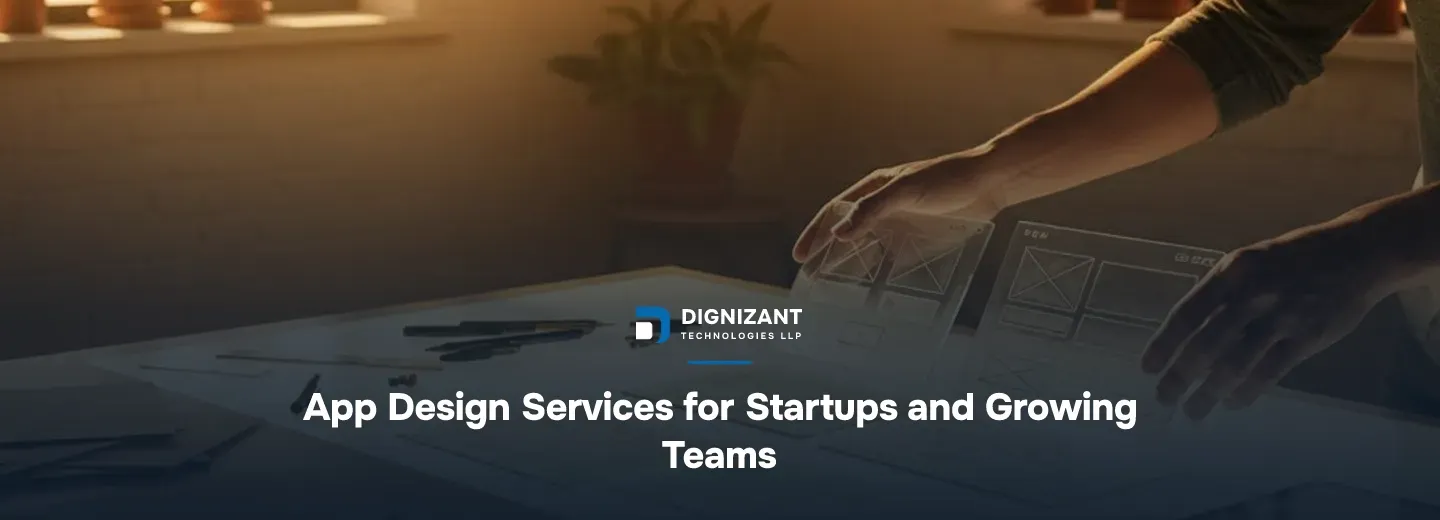
App Design Services for Startups and Growing Teams
Uploaded
6 hours ago
Read Time
8 Minutes
Views
1 view
App design services turn a product idea into a set of screens, flows, and interactions that a development team can build without guessing. This is for founders with an idea on paper, SaaS teams adding a new product line, and businesses replacing an app that users find confusing or slow. Dignizant Technologies LLP delivers this as a standalone service or as the first phase of a full build, so you can design now and decide later whether we also write the code.
The service sits between "we have an idea" and "we have working software." Skipping it is the single most common reason app projects run over budget, because changes made on a screen cost minutes while the same change made in production code costs days.
Who asks for this
Three kinds of buyers come to us for app design specifically:
- Startups with a concept, maybe a deck, and no visual direction yet. They need something investor-ready and build-ready at the same time.
- SMEs and SaaS companies adding a mobile companion to an existing web product, who need the new app to match an established brand and data model.
- Businesses with a live app that has a real problem: drop-off during signup, low repeat usage, or a support team fielding the same confusion every week.
Each of these has a different starting point, but the deliverables and process below apply to all three with small adjustments in scope.
What you get: deliverables and scope
A full app design engagement with Dignizant Technologies LLP produces a specific, checkable set of files, not a vague "design package."
Included in scope
- UX research and flow mapping: user journeys, task flows, and a sitemap showing every screen and how it connects.
- Wireframes: low-fidelity layouts for every screen, approved before any visual design starts.
- UI design: full visual design in your brand colors and type, for every screen state (empty, loading, error, success).
- Interactive prototype: a clickable version you can test with real users or show to investors before a line of code is written.
- Design system: a reusable library of components, spacing rules, and type styles so new screens later stay consistent.
- Developer handoff files: specs, assets, and redlines in a format your engineering team (ours or yours) can build from directly.
What is not included by default
- Backend architecture and database design are a separate engineering scope, though we price them together if you want one team end to end.
- Ongoing design updates after launch are handled as a support retainer, not folded into the initial fee.
- Brand identity work (logo, brand name, color palette from scratch) is a different, smaller project we can scope separately if you don't have a brand yet.
- App store assets (screenshots, preview videos) can be added to scope but are not automatic.
Being explicit about this matters because the single biggest source of disputes in design projects is scope that was assumed rather than written down.
How the engagement runs
The process is the same shape whether the app is a 6-screen MVP or a 40-screen SaaS product, just different in duration.
- Discovery call (free, 30 to 45 minutes): we ask about your users, your competitors, your platform choice (iOS, Android, both, or web-based), and what "done" looks like for you.
- Research and flow mapping (3 to 7 days): we document every user journey and get sign-off on the sitemap before touching visuals.
- Wireframes (4 to 8 days): structural layouts for every screen, reviewed with you over one or two rounds of feedback.
- UI design (1 to 3 weeks depending on screen count): full visual design, usually delivered in two or three batches so you see progress and can redirect early.
- Prototype and testing (3 to 5 days): a clickable prototype, optionally tested with a handful of real users before final sign-off.
- Handoff (2 to 3 days): final files, design system, and a walkthrough call with your development team.
You get a single point of contact throughout, usually a design lead who also attends the handoff call with developers, so nothing gets lost in translation between design and build.
Our own engineering team's take: most of the "the design doesn't work in code" complaints we've seen on other projects trace back to handoff, not design quality. A design that was never reviewed against real component constraints looks perfect in a prototype and falls apart the moment a developer tries to build it.
If you also want Dignizant Technologies LLP to build the app, design and development run as one continuous engagement, which removes the handoff risk entirely because the same team owns both ends.
What it costs
App design pricing scales with screen count, platform count, and how much original UX research is needed versus how much is already decided.
A simple MVP app (10 to 15 unique screens, one platform, standard patterns like login, feed, profile, settings) typically takes 110 to 180 design hours once you add research, wireframes, two rounds of revisions, and handoff. At realistic contractor and small-agency rates for this kind of work, that puts a basic MVP design in the range of $1,200 to $2,500.
A mid-complexity app (20 to 35 screens, both iOS and Android, a few custom components like dashboards or in-app payments) runs closer to 250 to 400 hours, landing around $2,800 to $5,500.
A complex, data-heavy product (40+ screens, multiple user roles, heavy custom visualization, a full design system built from scratch) can run 500 hours or more, which puts total design cost in the $6,000 to $9,000+ range.
What moves the number
- Screen count is the biggest single driver; a 15-screen app and a 45-screen app are not the same project even at the same "complexity."
- Platform count (designing separately for iOS and Android versus one shared design system) adds 20 to 30 percent.
- Original research (interviews, competitor teardown, usability testing) adds time upfront but reduces expensive rework later.
- Revision rounds beyond two or three per phase add cost; most of our clients settle a screen within two rounds once feedback is specific.
- Existing brand assets: a client with a locked brand guide moves faster than one deciding type and color as we go.
Project type | Screens | Platforms | Typical hours | Typical cost (USD) |
|---|---|---|---|---|
Simple MVP | 10-15 | 1 | 110-180 | $1,200-$2,500 |
Mid-complexity app | 20-35 | 2 | 250-400 | $2,800-$5,500 |
Complex/data-heavy product | 40+ | 2 | 500+ | $6,000-$9,000+ |
These figures are design-only. If you want design and development bundled, the total runs higher and is scoped separately once the design phase defines exactly what needs to be built.
How to judge any provider for this work
Whether you hire Dignizant Technologies LLP or someone else, ask these questions before signing anything.
- Can I see the actual files, not just a portfolio screenshot? Ask for a Figma link or equivalent from a past project, not a static image. A screenshot hides whether the design system is real or one-off.
- Do you test with real users, or only with internal opinions? A provider who never mentions usability testing is relying entirely on taste.
- What happens if I need to pivot halfway through? Get a straight answer on how mid-project scope changes are priced before you need to ask it for real.
- Who owns the final files? You should own 100 percent of the design files on final payment, full stop.
- Will the same team member who designs it also attend the developer handoff? If the answer is no, ask who explains the design decisions to the people building it.
- How do you handle platform differences? iOS and Android have genuinely different interaction conventions; a provider who designs one screen and stretches it to both platforms is cutting a corner that shows up in app store reviews later.
A design file that a developer has to guess at costs more in rework than the original design did. Ask any provider to show you a developer handoff package before you hire them, not after.
Compare that against hourly freelance marketplaces, where you often get a single generalist doing research, wireframes, and UI alone with no second reviewer. That can work for a very small app, but for anything with more than about 15 screens, a second set of eyes catches inconsistencies a solo designer misses.
Where this fits with the rest of your build
App design does not happen in isolation from the rest of your technical decisions. If your app is going to include an AI chat feature or assistant, that changes screen states and error handling in ways a generic design process won't anticipate; see our ChatGPT Integration Services page if that's part of your roadmap. Decisions about data handling also belong in design, not just engineering, so review our Privacy and Policy approach if your app touches user data, and our terms page for how we define the working relationship on any engagement.
Design decisions made without these considerations in mind tend to need rework once legal or technical review happens later. Raising them during discovery, rather than after handoff, is cheaper every time.
Proof points worth stating plainly
Dignizant Technologies LLP works with startups, SMEs, SaaS companies, and businesses worldwide on custom web, mobile, AI, and software development, which means app design at our studio is never done by a team that only does design and has never shipped the resulting code. That matters because a design team that has watched its own work go into production learns, over time, exactly which patterns cause build delays and which don't. According to the Nielsen Norman Group, one of the most cited authorities in usability research, usability testing with even a small number of real users catches the majority of a product's major usability problems before launch, which is why we build at least one testing checkpoint into every app design engagement rather than treating it as optional.
Start your app design project
If you have an idea, a rough sketch, or an existing app that isn't converting the way it should, the next step is a discovery call, not a long proposal document. Dignizant Technologies LLP will walk through your screens, your platform choice, and a realistic timeline and budget before you commit to anything. Reach out to Dignizant Technologies LLP to book that call and get a scoped estimate for your specific app.
Enjoyed this? Subscribe to our newsletter for more like it, straight to your inbox.
Latest Articles
Hire ecommerce developers for custom online stores. Real timelines, costs, and process from Dignizant Technologies. Launch faster, built to scale.
How Dignizant Technologies LLP built Anuroop Wiwaha, a matrimonial platform with secure matching, verified profiles, and a smooth mobile experience.
How to evaluate and hire the best React Native development company for your app, with real cost bands, timelines, and the questions to ask.
FAQs
Ready to Start Your Project?
Talk to our team about turning this into a real, working product.