Hire MERN Developers: Costs, Vetting, and Team Models
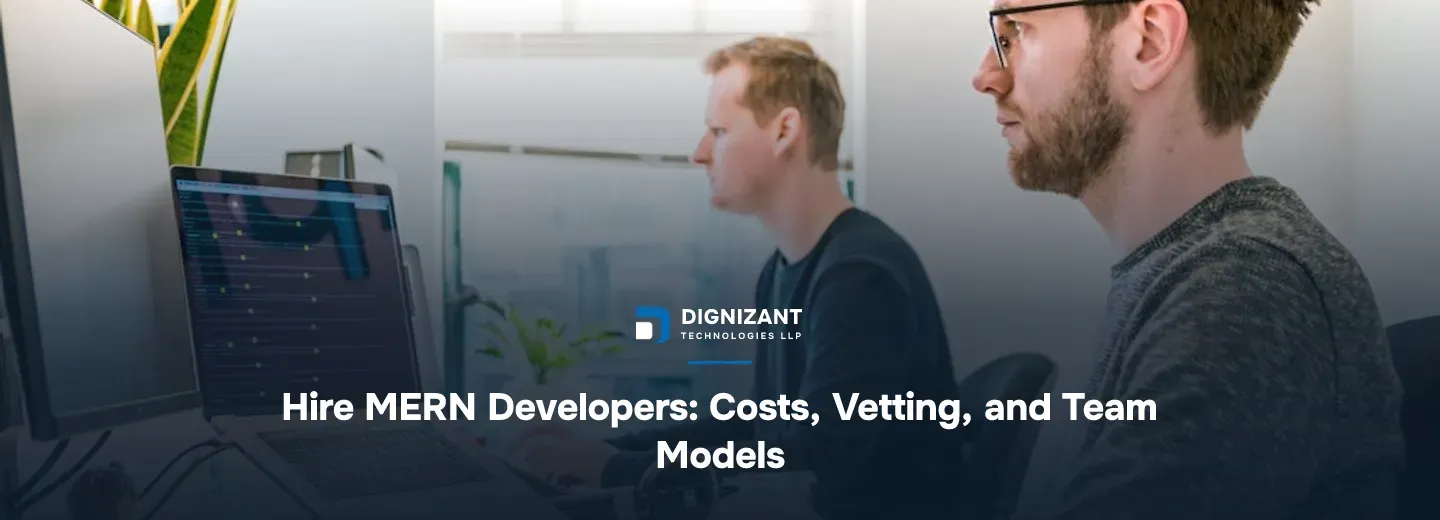
Photo by Tim van der Kuip on Unsplash
Uploaded
27 August, 2026
Read Time
7 Minutes
Views
24 views
Why MERN Is Still a Default Choice
MERN stands for MongoDB, Express, React, and Node.js. It's a JavaScript stack from database to browser, which means one language, one hiring pool, and fewer handoffs between frontend and backend work.
That's the practical reason it hasn't faded. A single developer who knows JavaScript well can move between the API layer and the UI layer without switching mental models. For a startup building an MVP or a mid-size company adding a customer portal, that flexibility cuts both time and cost.
React's own documentation still recommends Node-based tooling for most production React apps, and Node.js remains one of the most widely deployed runtimes for web backends according to the Stack Overflow Developer Survey year after year. This isn't a stack you're gambling on. It's a stack with a decade of production history and a job market deep enough that you're not stuck bidding for three developers in the whole world.
What You're Actually Hiring For
"Hire MERN developers" sounds like one task, but it usually breaks into three different needs depending on where your product sits.
- A full build from scratch - you have a spec or a rough idea and need the whole app built, database schema through deployment.
- Feature additions to an existing app - the codebase already exists and you need developers who can read someone else's code without breaking it.
- Ongoing maintenance and scaling - the app is live, has users, and now needs performance work, bug fixes, and new features on a steady drip.
Each of these needs a different hiring model, and conflating them is the single biggest reason companies end up unhappy with a MERN hire. A developer great at greenfield builds isn't automatically good at untangling five-year-old spaghetti code, and vice versa.
Real Cost Ranges for MERN Development
Cost estimates for "hire a developer" are usually vague to the point of uselessness. Here's a grounded way to think about it.
A realistic blended rate for skilled offshore MERN development work, factoring in developer time, project management, and QA, lands around $12 to $15 an hour in efficient delivery models. Scope drives the total far more than the hourly number does, so the honest answer is in the hours, not the rate.
Project Type | Typical Hours | Estimated Cost Range |
|---|---|---|
Simple MVP (auth, basic CRUD, one core feature) | 250-400 hours | $3,000-$6,000 |
Mid-complexity app (dashboards, payments, roles, API integrations) | 600-1,000 hours | $7,200-$15,000 |
Complex platform (marketplaces, real-time features, multi-tenant SaaS) | 1,500-3,000+ hours | $18,000-$45,000+ |
Ongoing maintenance (per month, part-time) | 40-80 hours/month | $480-$1,200/month |
These ranges assume a competent team working efficiently, not a single freelancer learning on the job at your expense. A poorly scoped project can blow past any of these numbers regardless of hourly rate, because rework costs more than getting it right the first time.
A mid-complexity MERN app with payments and role-based access typically runs 600 to 1,000 development hours. If a quote comes in dramatically under that for similar scope, the gap usually shows up later as bugs, not savings.
Freelancer, Agency, or In-House: The Real Trade-offs
This decision matters more than which specific developer you pick. Each model has a different failure mode, not just a different price tag.
Freelancers work well for small, well-defined tasks with a clear end point. The risk is availability. A freelancer juggling three clients will not drop everything when your app breaks in production at 11pm.
In-house hires make sense once you have steady, long-term product work and want full-time ownership. The cost is real: recruiting, onboarding, benefits, and the multi-week ramp-up before a new hire is fully productive. This model rarely makes sense for a single project.
Agencies sit in between. You get a team with built-in backup (if one developer is out, the project doesn't stall), project management, and usually QA baked in rather than bolted on. The trade-off is less day-to-day control over exactly who writes which line of code, though a good agency will still give you visibility into the team and the work.
Model | Best For | Typical Downside |
|---|---|---|
Freelancer | Small fixed-scope tasks, tight budgets | No backup if they're unavailable or leave |
In-house | Long-term, ongoing product ownership | Slow to hire, high fixed cost, ramp-up time |
Agency | Full builds, ongoing feature work, teams needing QA and PM | Less granular control over individual assignment |
Our own engineering team's take: the projects that go sideways almost never fail because of the framework. They fail because nobody defined what "done" looks like before the first line of code was written.
Vetting MERN Developers: What Actually Matters
Years of experience on a resume tells you almost nothing on its own. Here's what actually separates a developer who ships reliable code from one who doesn't.
- Ask for a code sample tied to a real feature, not a generic portfolio link. You want to see how they structure an Express route, not just a React component that renders nicely.
- Check how they handle state management in React. Overuse of global state or prop drilling in a sample project is a red flag for larger apps.
- Look at their MongoDB schema design. A developer who treats MongoDB like a relational database with no thought to embedding versus referencing will build something that gets slow fast.
- Confirm they've deployed to production, not just built locally. Deployment, environment variables, and CI/CD are where junior developers often fall short.
- Test their communication under a real constraint. Give them a vague requirement on purpose and see if they ask clarifying questions or just start coding.
A technical interview alone won't catch everything. Pairing it with a small paid trial task, something that takes 4 to 8 hours, is a cheap way to see real work before committing to a longer engagement.
Where Testing Fits In
Most companies hiring MERN developers focus entirely on the build and treat testing as an afterthought. That's backwards for anything beyond a throwaway prototype.
A MERN stack has three places bugs like to hide: MongoDB queries that work fine at 100 records and choke at 100,000, Express middleware that silently swallows errors, and React state updates that cause UI to drift out of sync with the backend. None of these show up in a quick manual click-through.
If your MERN developers aren't writing automated tests, or if you don't have a separate QA process, budget for it separately. Dignizant's software testing and qa services exist specifically because development and testing are different skills, and a developer testing their own code has a blind spot for their own assumptions.
Industry-Specific Considerations
Not every MERN project carries the same risk profile. A recipe-sharing app and a payments platform need very different levels of rigor even if both are technically "a MERN app."
For regulated industries, the stack choice matters less than the discipline around it. Financial applications need audit trails, encrypted data at rest, and careful handling of third-party payment APIs, on top of the usual MERN build. Dignizant's work in fintech software development reflects that: the code looks similar on the surface, but the review process, logging, and compliance checks around it are far heavier than a typical consumer app.
If your product touches money, health data, or personal identifiable information, ask any developer or agency directly how they handle data security and compliance before you hire, not after the first sprint.
After the Build: Launch and Growth
Building the app is maybe half the job. Getting people to actually use it is the other half, and it's a different skill set entirely.
Plenty of companies hire strong MERN developers, ship a solid product, and then wonder why nobody signs up. That's usually not a code problem. It's the absence of a go-to-market plan running alongside development.
If that's part of your gap, look at pairing development work with digital marketing support early, not as an afterthought six months after launch. The two workstreams inform each other: marketing needs to know what the product actually does well, and product roadmaps benefit from knowing what users are actually asking for.
Common Mistakes When Hiring MERN Developers
- Hiring for the cheapest hourly rate without checking total scope, which almost always costs more once rework starts.
- Skipping a written spec and expecting developers to fill in the gaps the way you would have.
- Treating React and Node experience as interchangeable skills when a candidate is actually stronger on one side than the other.
- No plan for code ownership if a freelancer disappears or an agency contract ends, leaving you locked out of your own codebase.
- Ignoring testing until after launch, when fixing a data model mistake means migrating live user data instead of just changing a schema.
Work With Dignizant
Hiring MERN developers is less about finding someone who knows the syntax and more about finding a team that can scope the work honestly, test what they build, and stay around long enough to fix what breaks. That's the standard worth holding any developer or agency to, including us.
If you're planning a MERN build, whether it's a first MVP or a feature-heavy platform that needs to scale, reach out to Dignizant and we'll walk through the scope with you before quoting a number.
Enjoyed this? Subscribe to our newsletter for more like it, straight to your inbox.
Latest Articles
Dignizant builds sports apps, fan platforms, and analytics tools for leagues, teams, and sports-tech startups. See scope, cost bands, and process.
Web analytics consulting that fixes bad tracking data and turns it into decisions. See process, timelines, and real cost bands from Dignizant.
A practical guide to hiring a web analytics consultancy: what the work involves, realistic costs, timelines, and how Dignizant Technologies LLP approaches it.
FAQs
Ready to Start Your Project?
Talk to our team about turning this into a real, working product.