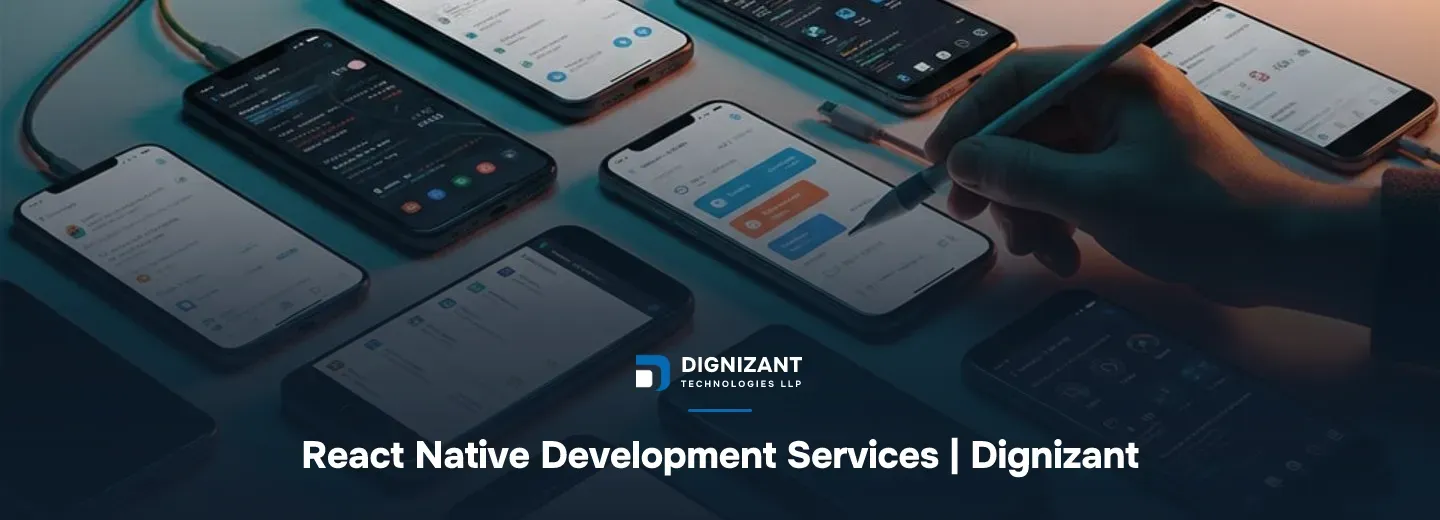
React Native Development Services | Dignizant
Uploaded
1 minute ago
Read Time
7 Minutes
Views
0 views
React Native development services cover the design, build, and launch of a mobile app from a single codebase that runs on both iOS and Android. This is for startups validating an idea fast, SMEs replacing a web-only product with a real app, and SaaS companies that need a mobile client for a product that already works on the browser.
If you have looked at hiring two separate native teams (one for Swift, one for Kotlin) and balked at the cost and coordination overhead, React Native is the practical middle path. It is not a shortcut that produces a lesser app. Companies like Shopify, Discord, and Microsoft run production React Native code at scale, and it remains Meta's flagship cross-platform framework for mobile, actively maintained and documented at reactnative.dev.
At Dignizant Technologies LLP, this work sits under our cross-platform app development services, where React Native is our default recommendation for most client apps unless there is a specific native requirement that rules it out.
What You Get: Scope, Deliverables, And What Is Not Included
Deliverables In A Typical Engagement
A React Native engagement should produce more than source code. Here is what a properly scoped project includes:
- A working app on both iOS and Android built from one shared codebase (typically 85-95% shared code, with small native modules where a platform truly needs them)
- UI/UX design files (wireframes, then high-fidelity screens) matched to your brand
- Backend API integration, or a new backend if you do not have one
- Push notifications, in-app purchases, and third-party SDKs (maps, payments, analytics) as needed
- App store and Play Store submission, including handling rejections and resubmissions
- A test build cycle (QA on real devices, not just simulators)
- Source code ownership and documentation handed to you, not held by the agency
What Is Usually Scoped Separately
Some things get bundled into a React Native quote by less careful vendors, and you should know to ask about them up front:
- Ongoing maintenance and OS-version updates after launch (usually a separate monthly retainer)
- Heavy custom native modules (certain Bluetooth hardware, AR, or background processing needs can require true native code, not just a bridge)
- Backend infrastructure scaling once you have real user volume
- Paid third-party services (maps API usage, SMS verification, push notification platforms) which bill you directly, not through your dev agency
- AI features such as a chatbot or recommendation engine; if that's on your roadmap, see our ChatGPT integration services for how that gets scoped separately
Our own engineering team's take: the single most common reason a React Native project runs over budget is a client discovering mid-build that one feature (usually something tied to a specific hardware sensor or background task) needs a true native module. We now flag this risk in discovery, not after the estimate is signed.
How The Engagement Runs
A React Native build follows a sequence that should not vary much between vendors, though the rigor inside each step does.
- Discovery (3-7 days). We map your must-have features against your budget and timeline, and flag anything that needs native code instead of a shared bridge.
- Design (1-3 weeks). Wireframes first, then high-fidelity UI screens, reviewed with you before any code is written.
- Build (6-16 weeks, depending on scope). Development happens in sprints, usually 2 weeks each, with a working build you can test at the end of every sprint, not just at the end of the project.
- QA and device testing (1-2 weeks, overlapping with the final sprints). Testing on real iOS and Android devices, not only simulators, because camera, GPS, and performance behavior differ.
- Launch (1-2 weeks). App store and Play Store submission, including handling any review rejections, which happen more often on the App Store than Play Store.
- Support (ongoing, optional). Bug fixes, OS updates, and feature additions after launch, usually billed monthly or per sprint.
You should have a single point of contact (a project manager or lead developer) through all of this, not a rotating cast of people you have to re-explain the project to. Ask any vendor you are considering how they staff communication, because this is where a lot of projects quietly go wrong.
What It Costs And What Moves The Number
Cost is the question every buyer actually wants answered first, so here it is in real terms.
A simple React Native app (a handful of screens, one backend integration, standard UI components, no custom native modules) runs roughly 120 to 250 development hours. A mid-complexity app (user accounts, a few third-party integrations, moderate custom UI, offline support) runs 300 to 600 hours. A complex app (real-time features, payments, heavy custom native modules, multi-role access) can run 700 to 1,200+ hours.
At a realistic blended rate for quality offshore and nearshore React Native teams, that translates to approximate total project cost bands:
App Complexity | Estimated Hours | Approximate Cost Range |
|---|---|---|
Simple (MVP, few screens) | 120-250 hrs | $1,500-$3,500 |
Mid-complexity (accounts, integrations) | 300-600 hrs | $4,000-$8,500 |
Complex (real-time, payments, custom native) | 700-1,200+ hrs | $9,500-$18,000+ |
What actually moves you up or down within these bands:
- Number and complexity of screens. Each additional unique screen with custom logic adds hours, not just design time.
- Backend work. If you need a backend built from scratch (not just connected to), add 20-40% to the estimate.
- Third-party integrations. Payment gateways, maps, and video calling each typically add 15-40 hours depending on the SDK's documentation quality.
- Design maturity. If you arrive with a finished Figma design, you save 1-3 weeks versus starting from a blank page.
- Native modules. Any feature that cannot run through React Native's standard bridge (certain hardware sensors, background audio, some AR) adds custom native development time on both iOS and Android separately.
- Testing depth. Automated test coverage adds hours up front but reduces bug-fix cycles later, which matters more the longer you plan to maintain the app.
A mid-complexity React Native app with user accounts, two or three integrations, and standard UI typically lands between $4,000 and $8,500 in total build cost, not counting app store fees or third-party service subscriptions.
If your product touches regulated money movement, cost estimates also need to account for compliance review, which is a different conversation. Our fintech software development page covers how that changes scope and timeline for financial apps specifically.
How To Judge A Provider For This Work
Price alone tells you almost nothing about whether a vendor can actually deliver. Here are the questions worth asking any agency you're evaluating, Dignizant included.
Technical Questions To Ask
- Can you show a React Native app you built that is live on the App Store or Play Store right now, not a screenshot?
- How do you decide when a feature needs a native module instead of a shared component, and who writes that native code?
- What version of React Native and its architecture (the current approach is the New Architecture with Fabric and TurboModules) do you build on by default?
- Do you write automated tests, or only manual QA?
- Who owns the source code and app store developer accounts after launch?
Process Questions To Ask
- Will I see a working build every sprint, or only at the end of the project?
- Who is my single point of contact, and what happens if that person leaves the project?
- What is your policy on scope changes mid-build, and how is that priced?
- What does post-launch support cost, and is it mandatory or optional?
If a vendor cannot answer the native-module question specifically, with a real example, that is a signal they have not shipped enough React Native apps to know where the framework's limits are. We cover more of these evaluation criteria in our buyer's guide to choosing a React Native development company, which goes deeper into red flags specific to this framework.
Proof Points Worth Weighing
React Native is not a niche or experimental choice. It is maintained by Meta, documented openly at reactnative.dev, and used in production by companies including Shopify, Discord, and Microsoft, spanning e-commerce, social, and enterprise software. That track record matters because it tells you the framework itself is not the risk in your project; the vendor's skill with it is.
Dignizant Technologies LLP builds React Native apps for startups and SMEs who need to move from idea to a working app on both stores without the cost of building two separate native teams. If you are earlier in the decision process and still weighing whether React Native fits a startup budget and timeline specifically, our piece on React Native development services for startups and SMEs walks through that comparison in more detail.
Our own delivery approach keeps design, build, and QA inside sprint cycles so you see a real build every two weeks rather than waiting months for a single reveal. We also scope native-module risk during discovery rather than discovering it mid-build, which is the single largest source of budget surprises we see across this kind of work.
Start The Conversation
If you are deciding between React Native and fully native development, or between agencies offering the same framework, the fastest way to get a real answer is a scoping conversation, not another sales page. Dignizant Technologies LLP will walk through your feature list, flag anything that needs native code, and give you a real hours estimate before you commit to anything. Reach out to Dignizant Technologies LLP to start that conversation, and review our terms whenever you're ready to move forward.
Enjoyed this? Subscribe to our newsletter for more like it, straight to your inbox.
Latest Articles

Web analytics consulting from Dignizant Technologies: fix tracking gaps, build dashboards that matter, and turn data into decisions. See cost and process.
Hire React Native developers for iOS and Android apps built from one codebase. See scope, timeline, cost bands, and how to vet a provider.

Hire ecommerce developers for custom online stores. Real timelines, costs, and process from Dignizant Technologies. Launch faster, built to scale.
FAQs
Ready to Start Your Project?
Talk to our team about turning this into a real, working product.