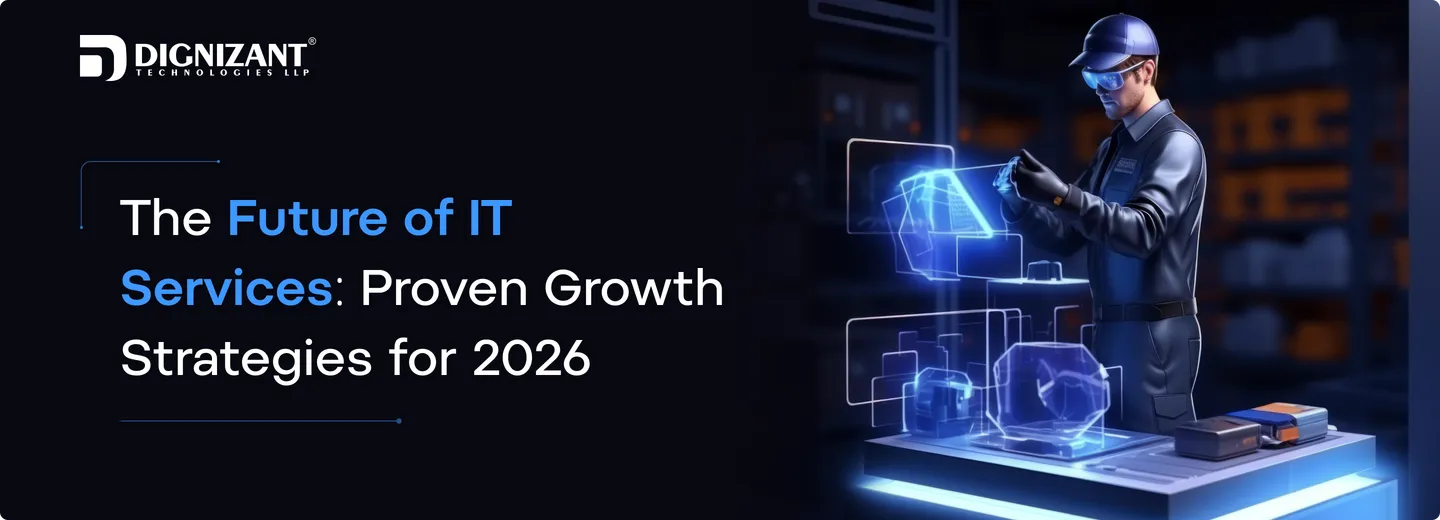
The Future of IT Services: Proven Growth Strategies for 2026
Contributor
Arjun Solanki
Uploaded
24 March, 2026
Read Time
8 Minutes
Views
53 views
The IT Services industry is entering into a defining phase. All these five years ago outsourcing development, basic web solutions, or generic digital services just don’t cut it anymore to keep yourself in the game. Smart, scalable outcome-driven technology is essential to attract businesses in 2026 as they consider which solutions can directly impact revenue, efficiency, and customer experience.
This transition is more than technological, it’s strategic.
For IT companies and service providers, What services do you offer? but on “How do you generate measurable business impact?”
In this blog, we encourage readers to look at the future of IT services in general with the support of veritable data and most importantly share actionable in practice growth strategies that help IT companies attract a pool of clients, reinforce authority and recurring leads.
The Evolution of IT Services: From Execution to Strategy
Traditionally, IT services were execution-oriented, clients arrived with needs, and firms provided solutions.
But in 2026, that model is ancient.
Modern clients expect their IT partners to:
- Offer strategic consultancy, not only development
- Understand industry-specific challenges
- Deliver ROI-driven solutions
- Continuously optimize systems post-launch
This evolution is a significant opportunity but also a challenge.
If you’re an IT business that is still defining itself as a “service provider,” then your primary competition is price.
If you position as a “growth partner,” then you compete on value.
Key Trends Shaping Future of IT Services in 2026
AI and Automation as Core Infrastructure
AI and automation are no longer experimental technology, they are the building blocks of modern IT systems.
Businesses are no longer asking whether or not they can incorporate AI, in 2026, they are asking how effectively it will drive results.
Predictive Systems
Predictive power is revolutionizing decision making in all sectors. Where they would have previously responded to historical data, businesses now make use of technology that predicts future results.
Examples include:
- Retail platforms predicting customer purchasing behavior
- Healthcare systems identifying potential health risks before symptoms appear
- Financial applications detecting fraud patterns in real time
However, the real value of predictive systems lies in their integration with business workflows. A predictive model without actionable output is simply data. Successful IT services focus on turning predictions into decisions.
This requires:
- Clean and structured data pipelines
- Continuous model optimization
- Seamless integration with business applications
Intelligent Workflows
Automation has evolved beyond rule-based systems. Modern workflows are now context-aware and adaptive.
Intelligent workflows can:
- Automatically assign tasks based on priority and workload
- Optimize supply chain operations in real time
- Personalize customer interactions across digital platforms
For example, in a customer support system, AI can:
- Analyze incoming queries
- Categorize them based on urgency
- Route them to the most relevant department
- Suggest responses to agents
It makes users spend less time searching their query and increases usability.
One of the insights here is that automation today is not about effort reduction, it’s about operational intelligence augmentation.
Rise of Industry-Specific Solutions
One of the biggest transitions for Future of IT services is moving from generic products to industry platforms. They want software that’s built for their specific operational challenges.
Why Industry Specialization Matters
Each industry has:
- Unique workflows
- Regulatory requirements
- Customer expectations
- Data structures
A generic solution often fails to address these nuances.
Real-World Industry Examples
Healthcare
Solutions must meet rigorous regulatory requirements, handle sensitive patient data, and integrate into medical systems. Telemedicine, electronic health records and AI diagnostics are common now.
Fintech
The applications demand superior security, real-time transaction processing, and compliance with financial regulations. Fraud detection and risk analysis are extremely valuable portions of it.
Retail
Businesses need systems for inventory, billing, customer analytics, and omnichannel experiences. Sales and customer behaviour need to be addressed in real-time.
Real Estate
Websites must handle property listings, customer relations, virtual tours and transaction processes. Auto lead management and follow-ups are becoming vital.
The strategic advantage of industry-specific solutions is clear:
- Faster implementation
- Higher client satisfaction
- Stronger differentiation in the market
For IT companies, specialization is no longer optional, it is a growth strategy.
Cloud-Native and Scalable Architectures
Scalability is one of the defining requirements of modern digital systems. Businesses expect applications that can handle growth without performance issues.
This is where cloud-native architectures become essential.
Microservices Architecture
Instead of building monolithic applications, modern systems are designed as independent, modular services.
Benefits include:
- Faster development cycles
- Easier maintenance and updates
- Improved fault isolation
- Scalability of individual components
For example, an eCommerce platform can scale its payment system independently from its product catalog.
Serverless Computing
Serverless architecture allows developers to focus on functionality without managing infrastructure.
Key advantages:
- Reduced operational complexity
- Cost efficiency (pay only for usage)
- Automatic scaling
This model is particularly effective for applications with variable workloads.
Edge Computing
With the rise of real-time applications, processing data closer to the user has become critical.
Edge computing enables:
- Faster response times
- Reduced latency
- Improved user experience
This is especially important for applications like IoT systems, gaming platforms, and real-time analytics.
The underlying principle here is not just scalability it is efficient scalability with optimized performance and cost.
Cybersecurity and Compliance First Approach
With organisations speeding up their digital transformation, so do the security risks. It is not just an afterthought in 2026, it is a foundational prerequisite.
Clients require IT solutions that are secure from the outset, rather than bolted on afterwards.
Data Protection as a Priority
Organizations work with all kinds of huge quantities of delicate information such as:
- Personal information
- Financial records
- Business-critical data
A single breach can result in:
- Financial losses
- Legal consequences
- Loss of customer trust
Therefore, IT services must integrate:
- Data encryption
- Secure authentication mechanisms
- Continuous monitoring systems
Regulatory Compliance
Different industries and regions have strict compliance requirements.
Examples include:
- Data privacy regulations
- Financial compliance standards
- Healthcare data protection laws
Failure to comply can lead to severe penalties.
Proactive Security Strategy
Modern AI based cybersecurity focuses on prevention rather than reaction.
This includes:
- Threat detection using AI
- Regular security audits
- Vulnerability assessments
- Zero-trust architecture
Outcome-Based Engagement Models
Perhaps the most transformative trend in the IT industry is the shift in how clients interact with service providers.
Traditional models focused on deliverables:
- Number of features
- Project timelines
- Development costs
What Clients Expect Today
Businesses now evaluate IT services based on:
- Increased revenue
- Improved efficiency
- Enhanced user engagement
- Reduced operational costs
This has led to the rise of objective-focused models.
What Is Outcome-Based Engagement?
In this model, success is monitored by business effect rather than project completion.
For example:
- A marketing platform is evaluated based on lead generation
- A mobile app is judged by user retention rates
- An automation system is measured by cost savings
Implications for IT Companies
This shift requires a fundamental change in approach.
IT companies must:
- Understand client business goals deeply
- Align technical solutions with measurable KPIs
- Provide ongoing optimization and support
This model also makes powerful partnerships, as both parties are invested in the same outcomes.
Strategic Advantage
Outcome-based engagement leads to:
- Higher client trust
- Long-term contracts
- Increased revenue potential
However, it also demands higher accountability and expertise.
Proven Growth Strategies for IT Services in 2026
Now let’s move beyond trends and concentrate on what actually drives growth.
1. Build Authority Through E-E-A-T Content
Google’s ranking systems focus more on Experience, Expertise, Authoritativeness, and Trustworthiness.
This means:
- Sharing real project case studies
- Publishing in-depth blogs (not generic content)
- Demonstrating technical expertise
- Showcasing team knowledge
For example, rather than writing “Top Web Development Trends,” write:
- How you improved a client’s conversion rate
- Technical challenges you solved
- Before and after performance metrics
If you are looking for specialist-driven solutions, explore our web development services designed to provide data-driven outcomes business outcomes.
2. Shift from Services to Solutions
A critical mistake many IT companies make is positioning their capabilities as generic services, such as:
- “We build apps”
- “We provide web development”
This is not compelling.
Instead, package your offerings as solutions:
- “Increase retail sales with smart POS systems”
- “Reduce operational costs with AI automation”
- “Scale your business with cloud-native platforms”
Clients don’t buy services. They buy results.
3. Productize Your Services
The future of IT services lies in productization.
Instead of fully custom solutions every time, create:
- Ready-to-deploy modules
- Industry-specific templates
- Subscription-based offerings
Example:
- POS system for retailers
- Booking platform for hospitality
- CRM for real estate
This approach:
- Reduces delivery time
- Improves margins
- Creates recurring revenue
4. Focus on High-Intent Lead Generation
Traffic alone does not generate business. Intent does.
To attract high-quality leads:
- Target long-tail keywords
- Optimize for buyer-focused queries
- Create solution-based landing pages
For example:
Instead of targeting
“mobile app development”
Target
“mobile app development for healthcare startups”
This significantly improves conversion rates.
5. Strengthen Trust Signals
In a crowded market, trust is the important differentiator.
To build trust:
- Showcase client testimonials
- Highlight real case studies
- Display certifications and partnerships
- Share team expertise
Also, ensure your website communicates:
- Clear value proposition
- Strong call-to-action
- Transparent service offerings
Your website should operate as a 24/7 sales engine, not merely a portfolio.
6. Invest in Long-Term SEO Strategy
SEO in 2026 goes beyond keyword stuffing and relying solely on backlinks.
It requires:
- Topical authority
- Content depth
- User intent alignment
- Technical SEO optimization
A strong SEO strategy includes:
- Pillar content (like this blog)
- Supporting cluster blogs
- Internal linking structure
- Regular updates
Consistency matters more than volume.
7. Adopt a Consultative Sales Approach
Clients today are more informed. They don’t respond to generic pitches.
Instead:
- Understand their business model
- Identify pain points
- Offer tailored solutions
This strategy elevates your company from a vendor to a trusted advisory partner.
The Role of Technology in Future of IT Services
Let’s challenge a common assumption:
“More technology automatically means better results.”
This is not entirely true.
The true value depends on how effectively technology is applied.
Successful IT companies in 2026 will:
- Combine AI with business logic
- Focus on usability, not just features
- Deliver scalable and maintainable systems
- Continuously optimize performance
Technology is an enabler not the outcome.
Common Mistakes IT Companies Must Avoid
Even experienced companies often fall into these traps:
1. Competing Only on Price
This leads to low margins and unsustainable growth.
2. Offering Too Many Services
Lack of focus weakens positioning.
3. Ignoring Branding
A weak brand reduces perceived value.
4. No Clear Differentiation
When you sound like everyone else, you become easy to ignore.
What Will Differentiate Winning IT Companies in 2026?
Success will favor not the largest companies, but those with the sharpest focus.
They will:
- Specialize in specific industries
- Deliver measurable outcomes
- Build strong digital authority
- Create scalable solutions
- Maintain long-term client relationships
Conclusion
The future of IT services is about delivering better outcomes, not just more solutions.
Businesses are no longer looking for vendors.
They are looking for partners who can accelerate business growth.
If your company can:
- Understand client challenges
- Deliver outcome-driven solutions
- Build trust through expertise
In 2026, you won’t merely survive, you will emerge as a leader.
Latest Articles
What it actually takes to build a Next.js app: real cost bands, timelines, team setup, and when to hire an agency instead of building it yourself.
Hiring a Next.js development agency? See scope, timeline, real cost bands, and questions to ask before you sign a contract with anyone.
Learn how to build a Next.js project step by step, when to hire help, and realistic cost and time ranges for different project sizes.
FAQs
Ready to Take Your Business to the Next Level?
Unlock new opportunities with expert solutions designed to elevate your brand. From strategy to execution, we empower your business with the tools, technology and talent it needs to thrive in today’s digital world.