Web App Design Services That Users Actually Trust
Uploaded
20 days ago
Read Time
7 Minutes
Views
11 views
What web app design services actually means
Web app design is the work of turning a product idea into screens people can navigate without thinking hard about it. This is different from a marketing website and different from raw front-end coding, though the three overlap in practice.
This service is for founders building a SaaS product, internal teams replacing a spreadsheet-driven process, and companies that already have a working app but are losing users to confusing navigation or a dated interface. If your users are logging in to do a job, not just reading a page, you need web app design, not a website redesign.
The two sentences that matter most for deciding whether you need this: a marketing site sells your product, a web app is your product. Design decisions in the second case affect churn, support tickets, and how fast your team can ship new features, not just how the brand looks.
What you get: deliverables and scope
A full web app design engagement produces artifacts your development team can build from without guessing. Here is what a complete scope typically includes.
- User flow maps covering every major task a user completes, from sign-up to the action that makes your product valuable
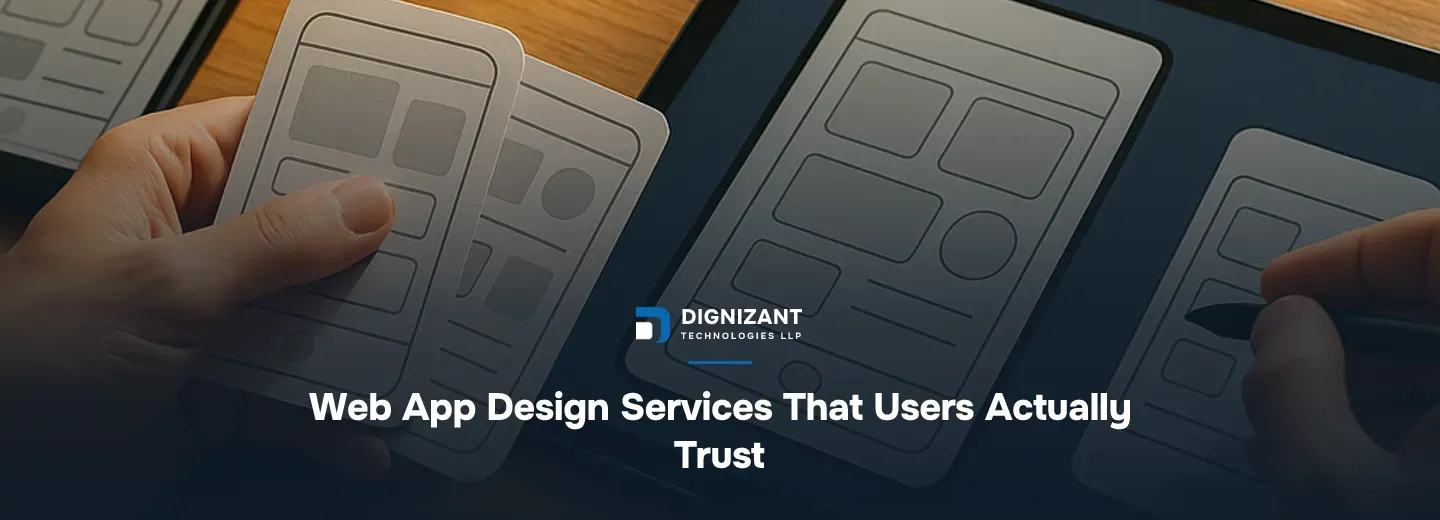
- Wireframes for core screens, showing layout and hierarchy before any visual styling
- A design system with components, spacing rules, color tokens, and typography that stay consistent as the product grows
- High-fidelity UI screens for desktop and responsive breakpoints, usually 15 to 40 screens depending on product complexity
- Interactive prototypes built in Figma so stakeholders and early users can click through before a single line of code is written
- A handoff package with specs, exported assets, and component documentation for your developers
What is usually not included, and should be scoped separately: front-end or back-end development, ongoing user research after launch, and copywriting for in-app content. Some agencies bundle these in; we scope them as clear add-ons so you know exactly what you are paying for and why.
If your project needs the app built as well as designed, that is a natural pairing with our web development services, and for products with an app store presence, our mobile app development team picks up the native or cross-platform build.
How the engagement runs
Most web app design projects move through five stages. The timeline below assumes a mid-size SaaS product with 8 to 12 core screens, not a simple form-based tool or a sprawling enterprise platform.
- Discovery (1 to 2 weeks): we interview your team and, where possible, a handful of real users. We map the current process, list pain points in the reader's own words, and define success metrics before touching a design tool.
- Information architecture (3 to 5 days): we lay out the site map and user flows. This is where confusing navigation gets fixed on paper, which is 10 times cheaper than fixing it after development.
- Wireframes and review (1 to 2 weeks): low-fidelity screens go to your team for feedback. We expect two rounds of revisions here, not open-ended iteration.
- Visual design and prototyping (2 to 4 weeks): full UI design and a clickable prototype. You get a working preview link, not a static PDF.
- Handoff and support (3 to 5 days): developer-ready specs, a design system file, and a walkthrough call with whoever builds the product, whether that is your in-house team or ours.
A straightforward web app runs 5 to 8 weeks start to finish. A complex product with role-based dashboards, multiple user types, or heavy data visualization runs 10 to 14 weeks. You should have a named lead designer as your single point of contact throughout, not a rotating cast of people who each know one piece of the project.
Fixing a confusing navigation structure at the wireframe stage costs a few hours of revision. Fixing the same problem after the app is built and users are already confused costs a rebuild, a support backlog, and a churn spike you'll only notice a quarter later.
What it costs and what moves the number
Design work is priced by scope and hours, not by guesswork, and the honest range depends on how many screens, how many user roles, and how much original research the project needs. Using a realistic hourly basis for skilled design and UX work, here is what real projects land at.
Project type | Typical scope | Realistic cost range |
|---|---|---|
Simple web app (MVP, single user role) | 6 to 10 screens, basic design system, no user research | $2,500 to $5,000 |
Standard SaaS product | 12 to 20 screens, multiple user roles, design system, prototype | $6,000 to $12,000 |
Complex platform (dashboards, analytics, multi-tenant) | 25+ screens, custom data visualization, user research | $13,000 to $25,000+ |
Redesign of an existing app | Audit plus 10 to 20 revised screens | $4,000 to $9,000 |
Four factors move a project from the low end to the high end of its band:
- Number of user roles. An app with an admin view, a customer view, and a team-member view triples the screen count compared to a single-role tool.
- Original user research. Interviewing 5 to 10 real users adds 1 to 2 weeks and meaningfully improves the outcome, but it is optional for very early MVPs.
- Design system maturity. Building a design system from scratch costs more upfront but saves money on every future screen and every future developer.
- Revision rounds. Two structured review rounds are included in the ranges above; unlimited open-ended revisions push any project toward its top figure or past it.
Cheap design that skips wireframes and user flows almost always costs more later, because developers end up building screens that get redesigned mid-sprint. That rework is rarely priced into the original "cheap" quote.
How to judge a design provider, including us
Ask any agency, including Dignizant, these questions before signing anything.
- Can I see the actual Figma file from a past project, not just a screenshot? A real working file shows you component structure and organization, which tells you how maintainable your own design system will be.
- Who is my single point of contact, and are they the person actually designing my screens? Account managers who relay feedback to a designer you never talk to slow everything down.
- What happens after handoff if my developers have questions? Good design partners include a walkthrough call and a short window of clarification support; find out how short. 4 How many revision rounds are included, and what happens past that number? This should be a specific number in the contract, not "we'll work with you."
- Do you design for the platform I'm actually building on? A team fluent in web app patterns is not automatically fluent in mobile-specific conventions, and vice versa.
- What research backs your interface decisions? Ask whether they follow established usability guidance, such as the heuristics published by Nielsen Norman Group, or whether decisions are made on personal taste alone.
Our own design team's take: the biggest cost overruns we've seen on other agencies' projects trace back to skipped wireframes, not expensive tools or slow designers. Teams that jump straight to high-fidelity screens end up redesigning in code, which costs three to five times more per screen than fixing it on paper.
Proof points worth checking
Rather than list claims we can't back with specifics, here is what to verify directly with any provider you're evaluating, including us: ask to see a live prototype link from a recent project, ask how long their last three engagements actually took against the original estimate, and ask for a reference call with a client whose product is still live today. A provider confident in their work will hand you all three without hesitation.
Dignizant works across web, mobile, AI, and software development for startups, SMEs, and SaaS companies worldwide, which means your web app design doesn't sit in isolation. If your project also needs marketing to launch it, our digital marketing services team can plan that in parallel. If you're designing a storefront or checkout flow specifically, our ecommerce app development team has patterns built for conversion, not just aesthetics.
Start with a conversation, not a contract
You don't need a finished spec to talk to us. Bring whatever you have, a rough idea, an existing app that needs fixing, or a set of user complaints, and we'll tell you honestly whether web app design is the right first step or whether you need something else first.
Ready to see what this looks like for your product? Reach out to Dignizant Technologies LLP and we'll walk through scope, timeline, and a real cost estimate on the first call.
Enjoyed this? Subscribe to our newsletter for more like it, straight to your inbox.
Latest Articles
Web analytics consulting that fixes bad tracking data and turns it into decisions. See process, timelines, and real cost bands from Dignizant.
A practical guide to hiring a web analytics consultancy: what the work involves, realistic costs, timelines, and how Dignizant Technologies LLP approaches it.
Hire Dignizant Technologies, an OTT platform development company, for custom streaming apps on web, mobile, and TV. See cost, timeline, and process.
FAQs
Ready to Start Your Project?
Talk to our team about turning this into a real, working product.