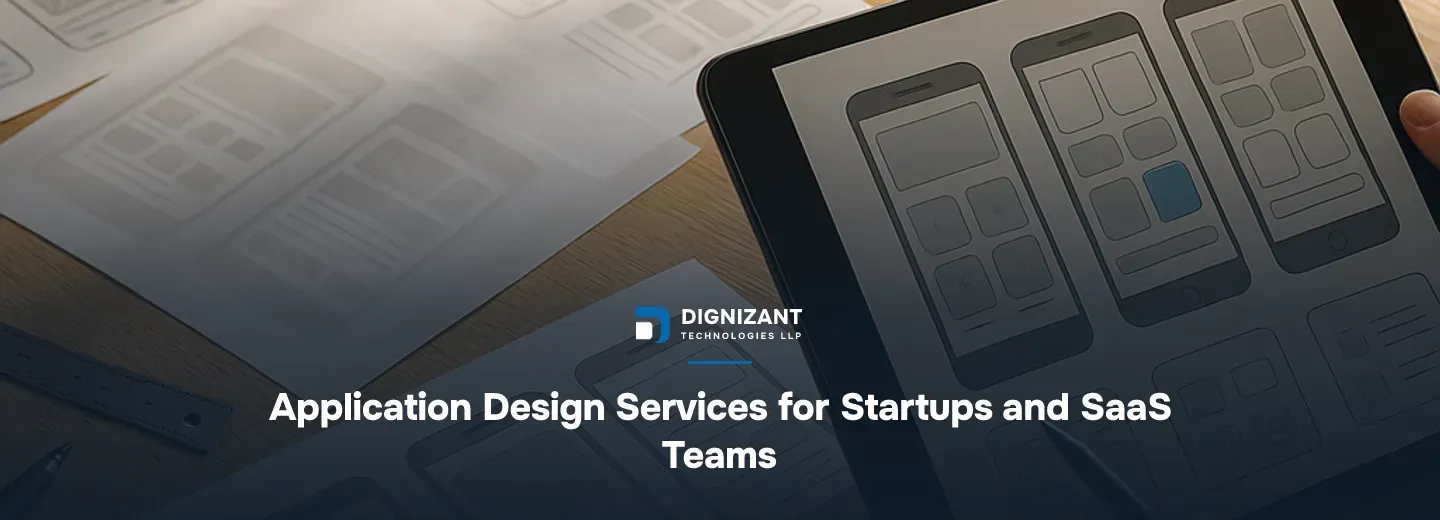
Application Design Services for Startups and SaaS Teams
Uploaded
10 minutes ago
Read Time
9 Minutes
Views
0 views
What Application Design Services Actually Cover
Application design services means designing how a web or mobile application looks, feels, and behaves before and during development. This is for startups building a first product, SaaS companies redesigning a clunky interface, and SMEs adding a new application to an existing business. If users are confused, dropping off, or complaining that your product "feels old," this is the service that fixes that, not a rebuild from scratch.
At Dignizant Technologies, we treat application design as a distinct phase of work, not a quick add-on to development. A developer who designs on the fly tends to produce screens that work but confuse users on day one. A designer who understands how the app will actually be built tends to produce something a development team can ship without reworking half of it. Good application design sits between those two failure modes.
This service applies to three common situations:
- New product, no design yet. You have an idea, maybe a rough wireframe on paper or in a slide deck, and need a real, testable design before anyone writes code.
- Existing product, falling behind. Your app works but looks dated, has inconsistent screens, or loses users at specific steps like onboarding or checkout.
- Scaling product, no design system. Every new feature looks slightly different because there is no shared set of components, and your team is rebuilding the same button five different ways.
What You Get: Deliverables and Scope
A proper application design engagement produces specific, usable artifacts, not just pretty pictures. Here is what is typically included:
- User research summary. Interviews, competitor review, or analysis of existing usage data to understand what users actually need, not just what stakeholders assume.
- Information architecture. A map of every screen, how they connect, and what happens on each one, done before any visual design starts.
- Wireframes. Low-fidelity layouts showing structure and flow, used to agree on functionality before spending time on color and typography.
- UI design (high-fidelity mockups). Final visual design for every screen, built in a tool like Figma, covering every state including empty states, errors, and loading.
- Interactive prototype. A clickable version of the design that behaves like the real app, used for stakeholder review and usability testing before development starts.
- Design system or component library. Reusable buttons, forms, cards, and patterns with defined spacing and color rules, so developers build consistently and future features do not need redesigning from zero.
- Developer handoff files. Specs, measurements, and assets exported in a format your development team (ours or anyone else's) can build from directly.
What is not included in a design engagement: the actual coding of the application, ongoing marketing of the product once it launches, and content writing for the app's copy, though we can coordinate with a content or digital marketing effort if you need one. Some clients also ask us to design the interface layer for an AI-powered feature, chatbot, or recommendation engine. That overlaps with our AI and ML development services when the design needs to account for how an AI model responds or where confidence scores and fallback states need to show up on screen.
How the Engagement Runs
Design work is sequential by nature. You cannot design a screen for a flow you have not mapped, and you cannot build a component library before you know what components the product needs. Here is the order we follow:
- Discovery (3 to 5 days). We review your existing product (if any), talk to 2 to 4 stakeholders, and define goals, target users, and constraints.
- Information architecture and wireframes (1 to 2 weeks). We map every screen and flow, then produce low-fidelity wireframes for review. This is the stage where functional disagreements get resolved, before visual design locks anything in.
- UI design (2 to 4 weeks). We design the high-fidelity screens, usually starting with 3 to 5 key screens for approval before expanding to the full set.
- Prototype and review (3 to 7 days). We build a clickable prototype and run it past your team or a small group of real users to catch problems before a single line of code is written.
- Design system handoff (3 to 5 days). We package components, specs, and assets for your development team, whether that is us or an in-house team.
- Build support (ongoing during development). We stay available to answer questions as developers implement the design, since real screens always raise questions a static mockup cannot answer.
A simple app (10 to 15 screens, one platform) typically takes 4 to 6 weeks end to end. A mid-size SaaS product (25 to 40 screens, web and possibly mobile) runs 8 to 12 weeks. A large or multi-role application with an admin panel, user-facing app, and a design system built to scale can run 12 to 16 weeks.
Throughout the project, you talk to one point of contact who coordinates the designer, not a different person every week. That person is who answers your questions between scheduled reviews, and it is the same person who sits in on handoff when development starts.
Our own engineering team's take: the single biggest cause of development delays we see is design that was approved without checking every state. A screen that looks great with sample data often breaks the moment it hits an empty list, a long username, or a failed API call, and catching that in design costs a day. Catching it in development costs a week.
What It Costs
Application design pricing scales with the number of screens, the number of user roles, and how much original research is needed versus working from an existing product. Based on realistic hourly effort for this kind of work, here is what the bands look like:
Project size | Screens | Typical scope | Cost range |
|---|---|---|---|
Small app or MVP | 10-15 | Wireframes, UI design, basic prototype, no design system | $1,800 - $3,500 |
Mid-size SaaS product | 25-40 | Full research, wireframes, UI, prototype, design system | $4,500 - $9,000 |
Large or multi-role app | 50+ | Admin + user app, scalable design system, usability testing | $10,000 - $18,000 |
What moves the number within and beyond these bands:
- Original research adds time. If you need user interviews and competitor analysis rather than working from an existing product and known requirements, add 15 to 25 percent to the estimate.
- Number of user roles. An app with separate admin, manager, and end-user views effectively needs three design tracks, not one, even if some components are shared.
- Platform count. Designing for web only is cheaper than designing matching web and mobile experiences, since mobile has its own layout rules and interaction patterns.
- Design system depth. A basic set of reusable components costs far less than a full design system with documented variants, states, and accessibility notes for every element.
- Revision rounds. Most engagements include 2 to 3 rounds of feedback per major deliverable. Open-ended revisions without a defined scope is the most common reason a design project runs over budget.
These figures are for design only. Development to build the designed application is a separate, additional cost, and we will scope that separately once the design is locked, since build cost depends heavily on the technology stack and feature complexity.
How to Judge a Design Provider, Including Us
Most buyers cannot evaluate visual design quality directly, which is fine, because visual taste is not actually the most important thing to check. Ask any provider, including Dignizant Technologies, these questions before signing:
- Can I see the design files, not just final screenshots? Working designers show you Figma or an equivalent tool, live, not just exported images. If a provider only sends PNGs, you cannot verify the work is organized or handed off cleanly.
- Who talks to my developers during handoff? If the answer is "the designer moves to another project after delivery," expect friction during build. Ask who stays available and for how long.
- Do you design every state, or just the happy path? Empty states, errors, loading, and edge cases are where most design gaps show up later. A provider who cannot answer this confidently has probably skipped it before.
- How many revision rounds are included, and what happens after that? Vague answers here lead to scope creep arguments later. Get the number in writing.
- Will I own the files? Confirm you get the source Figma file and all assets, not just a link that disappears when the contract ends. Review any provider's terms on this, including our own terms and conditions, before signing.
- Have you designed for my type of product before? A consumer mobile app and a B2B admin dashboard require different design instincts. Ask for examples closest to your actual use case.
A provider who answers these quickly and specifically is usually fine to work with. One who gets vague on handoff process or ownership is a warning sign regardless of how good their portfolio looks.
Design-Only vs. Design-and-Build: A Real Trade-off
Some clients want design only, planning to hand it to an in-house or separate development team. Others want one team to carry the project from design through launch. Both are legitimate choices, but they carry different risks.
Factor | Design-only | Design and build together |
|---|---|---|
Handoff risk | Higher, since a separate dev team may misread specs | Lower, since the same team controls both |
Cost | Lower upfront | Higher total, but fewer rework cycles |
Speed | Slower, with a gap between design sign-off and build start | Faster, since build can start on partially approved screens |
Best for | Teams with a strong in-house dev team already | Teams without an existing dev team, or launching fast |
If you already have developers who know your codebase well, design-only can work fine and save money. If you do not have a development team lined up, or if speed matters more than saving on the design line item, having one team handle both removes the handoff gap entirely. Dignizant Technologies offers both, and we will tell you honestly which fits your situation rather than pushing the more expensive option by default.
Proof This Approach Works
Good process is not a guess. The Nielsen Norman Group, a well-established authority on usability research, has published findings for decades showing that catching usability problems during design review, before development, costs a fraction of fixing the same problem post-launch. That is the entire reason our process puts wireframe and prototype review before any pixel-perfect UI work: catching a flawed flow in a wireframe takes an afternoon, catching it in a finished app takes a rebuild.
A design system is not a nice-to-have for teams past 20 screens. It is the difference between a developer building a new feature in 2 days versus 5, because the components already exist and already match.
We built our process around that principle deliberately. Every mid-size or larger engagement at Dignizant Technologies includes a design system deliverable, not as an upsell but because skipping it costs the client more time later than it saves now.
Start the Conversation
If you have a product idea, a product that needs a redesign, or a growing app that needs a real design system before it gets harder to manage, the next step is a short conversation, not a long proposal. Tell us your screen count, your platform (web, mobile, or both), and whether you have developers lined up already. From there we can give you a specific scope and price band within a day or two, not a vague "it depends" answer.
Reach out to Dignizant Technologies to talk through your application and get a real scope and quote for the design work ahead.
Enjoyed this? Subscribe to our newsletter for more like it, straight to your inbox.
Latest Articles
Hire dedicated Node.js developers from Dignizant Technologies LLP. Real cost bands, team structure, timelines, and what to check before you sign a contract.
A grounded comparison of the best serverless frameworks, what each costs to build with, and how to pick the right one for your product.
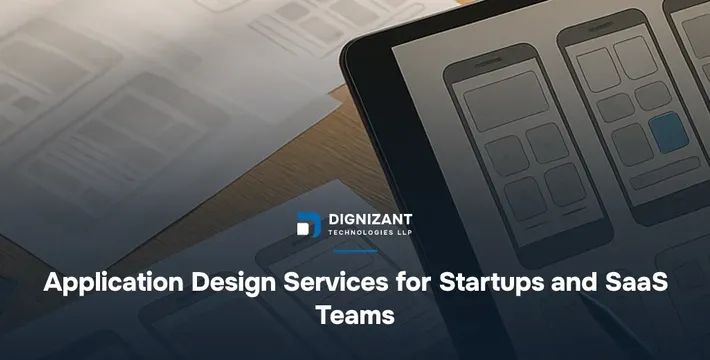
Application design services from Dignizant Technologies: UX research, UI design, prototyping, and design systems. See scope, cost, and timeline.
FAQs
Ready to Start Your Project?
Talk to our team about turning this into a real, working product.