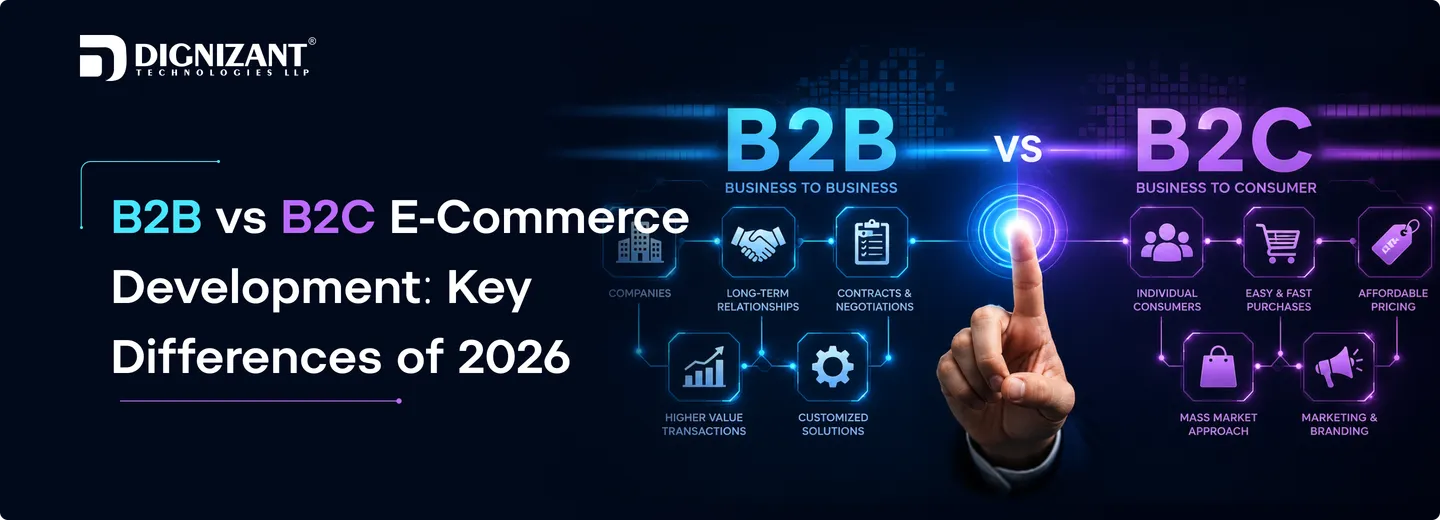
B2B vs B2C eCommerce Development: Key Differences of 2026
Contributor
Palash Pandya
Uploaded
23 July, 2026
Read Time
11 Minutes
Views
33 views
So what are the differences? Both can be confusing for online sellers, what with selling online to other businesses versus selling online to consumers. If you choose the wrong one, you are forcing poor customer experience, slow sales, and wasting money. This blog might be useful to you regarding B2B vs B2C eCommerce Development in an easy way so it's easy for you to take the best decision.
Find out what separates B2B vs B2C eCommerce, how both work and which is best suited for your business goals in 2026. It also discusses critical features, customer considerations, buying policies, and advantages of both models. So at the end of this article, you’ll be able to decide on which eCommerce solution will make your business grow faster and serve your customers better.
What Is B2B eCommerce Development?
B2B eCommerce development is the process of building a B2B online store where a business sells its products or services to another business. A manufacturer, for example, can sell its products to a wholesaler or a supplier can provide the retailer with materials. These platforms are designed to manage huge order volumes, complicated discounts, and lasting business partnerships. In addition, many organizations opt for mobile ecommerce app development so customers could order, track their shipments, and access their accounts on the go.
A B2B eCommerce site is not like your average online shopping website, as it caters to business customers and not individual end users. It also supports bulk ordering, secure payments, customer-specific pricing, and account management. A B2B platform that is well executed can save businesses time, increase order accuracy and simplify the buying journey.
Advantages of B2B eCommerce Development
Development of B2B eCommerce is designed to assist companies to provide their products and services to other companies more quickly and easily. It streamlines the purchasing process, enhances the customer experience and fuels business growth over the long term.
1. Fast order management
B2B eCommerce enables buyers to place orders, view previous orders, and take advantage of many other features. Businesses can rapidly fulfil orders, and minimize manual work, and prevent ordering errors. Both buyers and sellers save time.
2. Better Customer Experience
Business buyers have a single source for order history, reordering products, checking prices and tracking deliveries. It simplifies shopping and in turn helps you gain customers trust.
3. Supports Bulk Orders
Most business consumers buy items in bulk. B2B eCommerce websites are built to manage bulk orders and custom pricing with special discounts and still be user-friendly and easy to use.
4. Increases Business Sales
An online B2B store is available 24/7, allowing customers to place orders whenever they need. Thus, this allows seller to extend their reach, get more orders and increase sales without solely relying on a sales team.
5. Reduces Business Costs
Online orders eliminate business process waste, paperwork, phone calls, and manual data entry. Businesses can streamline routine activities, reduce business expenses, and become more productive in a general sense.
6. Easy Business Growth
A scalable B2B eCommerce platform can grow with the business. New products, customers, payment types, and markets can swiftly be added, so your company can expand without significant system modifications.
Disadvantages of B2B eCommerce Development
B2B eCommerce development provides many opportunities, however, there are also some challenges. Before developing an online platform, businesses should be aware of these aspects to enable them to plan appropriately and they will able to avoid running into any problems.
1. Higher Initial Investment
Building a B2B eCommerce website is usually more expensive than creating a regular online store. You might need custom features, secure payment methods, and business software integration. Partnering with a reliable custom software development company can assist enterprises to develop right solution without superfluous expenses.
2. Longer Development Time
Custom B2B Sites B2B websites generally require more complex functionality than B2C sites, including bulk ordering, customer-unique pricing, multiple user profiles, and inventory management. For these reasons, development and testing can take more time.
3. Complex System Integration
Many businesses must integrate their eCommerce solution with ERP, CRM, accounting and inventory systems. If these systems are not well integrated, the business process may slow down and result in errors in the data.
4. User Training May Be Required
Staff and corporate clients might have to be trained on the new site. They may not be able to fully exploit the features without training.
5. Regular Maintenance and Updates
A B2B eCommerce site requires constant security updates, bug fixes and feature enhancements. Continuous maintenance is crucial for preserving relevance and an up-to-date platform for a developing business.
What Is B2C eCommerce Development?
B2C eCommerce development is a set of processes involved in the building of an eCommerce portal that enables a company to sell products or services to individual customers. People can enter the website or mobile application, find the products, put the items in the cart, pay safely, and get the order delivered to their home. Dating apps are great examples, and so are online stores for clothing, electronics, groceries, and beauty items.
B2C eCommerce website development makes the entire shopping fast, easy and fun for consumers. It is equipped with easy product search, secure checkout, multiple payment options, customer reviews, order tracking, etc. An ideal B2C website can help businesses engage more customers, enhance shopping experience, and drive more sales.
Advantages of B2C eCommerce Development
B2C eCommerce development offers an easy and effective medium for businesses to sell their products directly to consumers. It allows for a simple, quick, and convenient shopping experience for consumers while enabling businesses to expand their reach and increase sales.
1. Reach More Customers
B2C online stores empower the organization to sell the products to customers in other cities and countries. Unlike a physical store, an online store is accessible 24 hours a day, which can help you gain more customers as well as more profits.
2. Better Shopping Experience
Buyers can look for products, compare prices, get reviews, and buy with a few clicks of the mouse. An enjoyable shopping experience equals satisfied customers who are more likely to return.
3. Faster Sales Process
Customers can interact with the products, but they don’t have to go into a store or speak to a sales associate to buy them. The combination of simple checkout, secure payments and speedy order confirmation makes for more sales in less time.
4. Lower Business Costs
Maintaining an online store is typically less expensive than running a physical store. Organizations can reduce their business overhead by doing away with mall rent, utilities and more daily costs and still have the possibility of reaching more customers via one platform.
5. Easy Marketing and Customer Engagement
Companies can market their products via email, social media, search engines and online advertisements. A reputable digital marketing company may also increase the traffic of your site, enhance visibility of your brand, and bring in more customers.
6. Business Growth and Scalability
As the demand increases, they can simply add more products, payment, and delivery methods. A scalable B2C eCommerce system accommodates growth over time without significant system revisions.
Disadvantages of B2C eCommerce Development
B2C eCommerce development enables companies to sell online, but there are associated challenges. Understanding these drawbacks may assist companies in making more informed decisions and planning for the future.
1. High Competition
There are a lot of companies selling similar products on the internet, it is rather hard to tell them apart. Businesses require competitive pricing, quality goods, and a positive customer experience to win and maintain buyers.
2. Customer Acquisition Can Be Expensive
Acquiring new customers usually involves spending money on SEO, social media, or paid ads. Businesses may have to continually doorkeep to generate website traffic and sales.
3. Managing Returns and Refunds
Customers can return products for a myriad of reasons including incorrect size or damaged goods. Processing returns, refunds, and exchanges might also increase the business's expenses and consume more time.
4. Security and data safety
Like retail stores, online stores gather customer data including payment details and addresses. You need robust security protocols to defend this data against cyberattacks. Businesses pick AI ML development services for enhanced fraud detection capabilities, real-time monitoring for suspicious activities, and overall system security.
5. Ongoing Maintenance and Updates
The B2C ecommerce website requires frequent updating, application of security patches and fine tuning on performance. Without regular upkeep, the site could become sluggish, insecure, or outpaced by changing customer demands.
Key Differences Between B2B and B2C eCommerce Development
It is essential to select the right eCommerce model if you want your business to look trustworthy. They are both platforms to help businesses sell via their own websites, however, these platforms differ in some significant ways. What is b2b vs b2c ecommerce and how do you choose the right option for your business based on your customers, products, and business targets.
1. Target Audience
B2B: A business sells to other businesses, such as wholesalers and retailers, or manufacturers who consume the product. These buyers typically buy on behalf of their organization or company.
B2C: A company sells products directly to the end consumer who buys for their own consumption. The decision to buy is quicker and more personal.
2. Buying Process
B2B: The purchasing process takes longer since more individuals can be involved in the decision. Customers comparison shop, ask for quotes, and negotiate business terms before making a purchase.
B2C: Buyers can look for products, put things into the cart, pay online, and get the purchase done all within a couple of minutes.
3. Pricing Models
B2B: Pricing is often different for each buyer. Companies may have negotiated prices or special contract rates.
B2C: The price of the same product is usually the same for all customers. Get Discounts during sales, festivals and in promotional schemes.
4. Order Volume
B2B: Trade businesses place orders in high quantities, if not in bulk, because they are either selling them or using them as supplies.
B2C: Individual consumers usually purchase one or few products at a time.
5. Customer Experience
B2B: Business is the ease of making a transaction with bulk ordering, account management and custom pricing. A lot of enterprises hire saas product development services to create SaaS-based products that are more beneficial in terms of managing business.
B2C: The objective is to offer a seamless and delightful shopping experience including straightforward navigation, swift checkout, product evaluations, and customized suggestions.
6. Payment Options
B2B: Payment methods are usually bank transfers, invoices, credit terms and purchase orders, as businesses can’t always pay on the spot.
B2C: Consumers usually pay on the spot with credit/debit cards, digital wallets, UPI, or net banking.
7. Sales Cycle
B2B: The sales cycle is longer since businesses take time to assess products, negotiate prices, and obtain approvals prior to buying.
B2C: The sales cycle is shorter as customers can do some instant shopping based on what they want and need.
8. Marketing Strategy
B2B: Marketing is about trust, education and quality business leads. Businesses often hire dedicated PHP developers to develop custom eCommerce solutions for complex business requirements and to enhance the performance of platforms.
B2C: Marketing is all about driving customers on social via organic, SEO, email marketing, discounts and fun product promotions. In b2b and b2c ecommerce, you’ll notice a difference in how marketing strategies are structured.
Deciding Which is better for your business: b2b vs b2c ecommerce
If you are confused about ecommerce b2b vs b2c, here is a simple way to decide:
🔹 Choose B2B eCommerce if:
- You sell products or services to other businesses
- Your customers place bulk orders
- You need custom pricing and business accounts
- Your sales process involves quotes or approvals
- You want long-term business relationships
🔹 Choose B2C eCommerce if:
- You sell directly to individual customers
- You want fast and simple online purchases
- Your products have fixed pricing
- You focus on customer experience and quick checkout
- You want to increase online sales with digital marketing
There is no single winner. Both B2B and B2C eCommerce models offer unique benefits. The right choice depends on your business type, target customers, products, and long-term goals.
Common Mistakes to Avoid When Choosing an eCommerce Model
Selecting the right eCommerce model is key for business success. Too many companies make simple errors that retard their development and decrease sales. Knowledge of b2c vs b2b ecommerce will help you prevent these difficulties and identify the best option.
1. Choosing the Wrong Target Audience
Some companies opt for the B2B model when they ought to sell directly to consumers, or the B2C model when their true clients are other businesses. Always know who your buyers are before you know what to do.
2. Ignoring Business Goals
Every business has its own distinct objectives. When you select an eCommerce model without considering your future expansion, products, and customer requirements, you may face difficulties later on.
3. Overlooking Required Features
The features required for b2b and b2c platforms are distinct. Failure to add the right features, such as bulk ordering or a quick checkout, can lead to less satisfied customers.
4. Focusing Only on Cost
Opting for the cheapest alternative can be a great way to save money initially, but it can also result in poor quality and more costs down the road. Consider long-term value, not just short-term price.
5. Not Planning for Future Growth
Too many companies build a platform that only works for today. Choosing a scalable eCommerce solution will enable you to expand your business and accommodate more customers, products and sales as your business grows.
Why Choose Dignizant as a Professional eCommerce Development Company?
Dignizant is a leading eCommerce app development company that helps entrepreneurs, small businesses and large enterprises to develop a best online shopping platform. With our skilled developers, we develop technical, reliable, and user-friendly eCommerce websites and mobile applications for B2B and B2C businesses. We specialize in learning your business challenges and creating custom solutions that enhance the customer experience, increase sales, and support sustainable growth.
Planning, designing, developing, testing, launching and maintaining – Dignizant offers all the eCommerce development services you will ever need, from JS to Python. We utilize modern technologies, scalable architectures, and industry best practices to produce enterprise-quality solutions that evolve with your business. If you are looking for a new eCommerce platform or considering an upgrade, we have got you covered. Contact us now to talk about your project and make an eCommerce solution that suits your business needs.
Conclusion
The decision to go either for B2B or B2C eCommerce development depends on your business objectives, target customers, and the method of selling your products or services. B2B is geared towards companies that sell to other companies and B2C is for companies that sell to consumers. Knowing what to expect and the main differences, features, advantages and disadvantages of both types of business models will help you make the right decision for the growth of your company. Your choice of eCommerce platform will determine how well you can enhance the customer experience, boost your sales, and create a thriving business online in 2026 and hopefully beyond.
Latest Articles
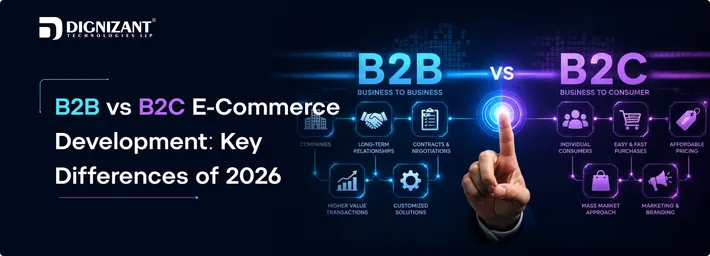
Confused about B2B vs B2C eCommerce Development? Learn the key differences in 2026 to choose the right solution for faster business growth.
Planning to hire FlutterFlow developer? Avoid 7 costly mistakes businesses make to save time, reduce risk, and build a successful app faster.
Hire a FlutterFlow developer to build Firebase-powered startup apps fast. Learn setup, costs, and best practices in this 2026 guide.
FAQs
Ready to Take Your Business to the Next Level?
Unlock new opportunities with expert solutions designed to elevate your brand. From strategy to execution, we empower your business with the tools, technology and talent it needs to thrive in today’s digital world.