Media and Entertainment Software Development Company
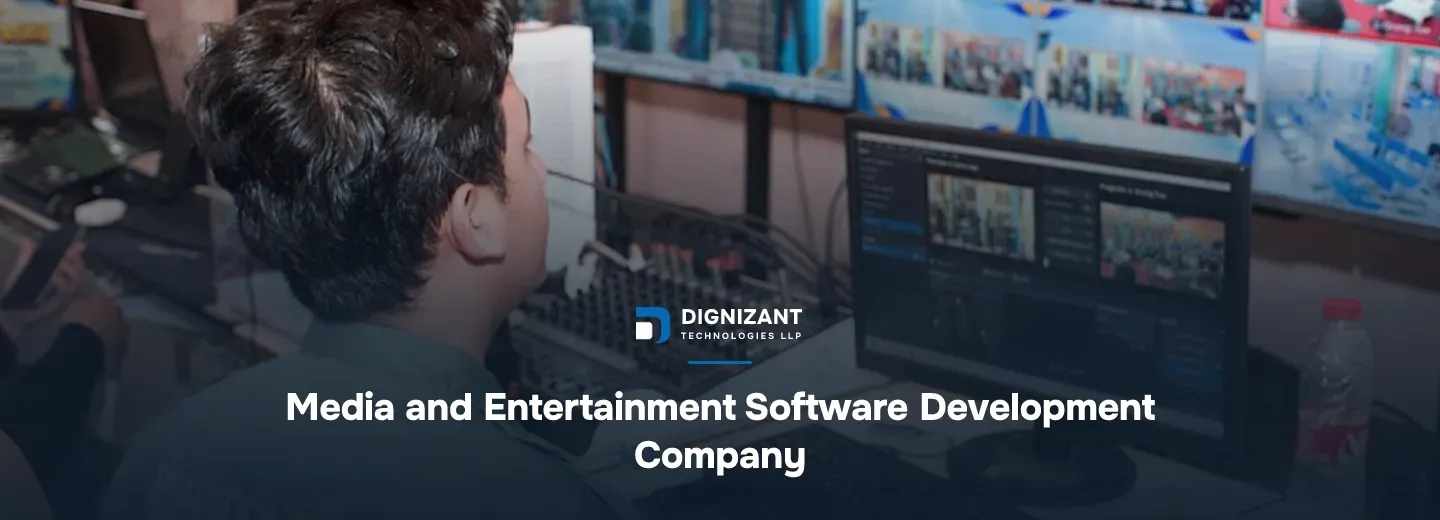
Photo by Qeis Ismail on Unsplash
Uploaded
30 August, 2026
Read Time
7 Minutes
Views
13 views
Why Media and Entertainment Software Is Its Own Category
Media and entertainment software is not the same problem as a business dashboard or an internal tool. It has to handle video at scale, live events with zero tolerance for buffering, rights management across regions, and content that changes by the minute. A generic software vendor can build you a working app. A media and entertainment software development company builds one that survives a Friday night traffic spike without falling over.
The stakes are different too. If a CRM goes down for 20 minutes, someone grumbles. If a live sports stream drops during the final minutes of a match, you lose subscribers and get flooded with support tickets and refund requests. This is why the buying decision for this kind of software deserves more scrutiny than most internal business tools.
This piece walks through what actually goes into building media and entertainment platforms, what it costs in realistic ranges, how long it takes, and what separates a company that can deliver this from one that just says it can.
What Falls Under Media and Entertainment Software
The category is broader than most people assume when they start searching for a vendor. It typically includes:
- Streaming platforms for video on demand (VOD) or live streaming
- OTT apps across web, mobile, smart TV, and connected devices (Roku, Apple TV, Fire TV, Android TV)
- Content management systems (CMS) built specifically for media libraries, metadata, and licensing windows
- Digital rights management (DRM) integration for protecting paid content
- Ad insertion systems for server-side or client-side ad stitching (SSAI/CSAI)
- Recommendation engines that personalize what a viewer sees next
- Ticketing and events platforms for concerts, festivals, and live experiences
- Gaming and interactive media backends
- Podcast and audio distribution tools
- Analytics dashboards tracking watch time, churn, and engagement per title
Most projects touch three or four of these at once, not just one. A streaming app almost always needs a CMS behind it and some form of DRM in front of it.
The Real Cost of Building Media Software
Cost ranges vary enormously in this space because the scope varies enormously, so it is worth breaking apart by project type rather than giving one number.
A basic VOD app (web plus one mobile platform, a simple content library, no live streaming, standard DRM through a third-party service like Widevine or FairPlay) typically takes 500 to 900 development hours across design, backend, frontend, and QA. At a realistic blended rate for offshore-quality development in the $10 to $15 per hour range, that lands the project between $5,000 and $13,500. This covers a functional MVP, not a polished multi-platform launch.
A multi-platform OTT app (web, iOS, Android, plus one or two smart TV platforms, live and on-demand content, ad insertion, a custom CMS) is a much bigger build. Expect 2,000 to 4,000 hours once you include backend infrastructure, DRM integration, transcoding pipelines, and testing across devices. That puts total cost in the $20,000 to $60,000 range, sometimes higher if you need support for more than four device platforms or a custom recommendation engine.
A live streaming platform with low-latency requirements (sports, esports, live events) adds real complexity: adaptive bitrate streaming, CDN configuration, real-time chat or interaction features, and load testing for concurrent viewer spikes. These projects commonly run 3,000 to 6,000 hours, putting cost between $30,000 and $90,000 depending on how many simultaneous viewers the system needs to support and how many regions it needs to serve.
A ticketing or events platform with payment processing, seat mapping, and fraud prevention typically falls in the 1,200 to 2,500 hour range, translating to roughly $12,000 to $37,500.
A single hour of live video test coverage across five device types, three network conditions, and two ad-insertion states can easily produce 40+ individual test cases. Skipping that step is how platforms end up debugging a buffering complaint in production instead of catching it before launch.
These ranges assume a development partner working efficiently with a clear scope. Vague requirements, frequent pivots, or building custom DRM from scratch instead of using established SDKs can push any of these bands significantly higher.
Timeline Expectations
Media platforms take longer than typical business software because so much depends on integrations you do not control: DRM vendors, CDN providers, app store review processes, and smart TV platform certification.
Project Type | Typical Timeline | Key Bottleneck |
|---|---|---|
Basic VOD app (web + 1 mobile) | 3 to 5 months | Content ingestion workflow, app store review |
Multi-platform OTT app | 6 to 10 months | Smart TV certification, DRM integration |
Live streaming platform | 7 to 12 months | Load testing, CDN configuration, latency tuning |
Ticketing/events platform | 4 to 6 months | Payment gateway compliance, seat map logic |
Smart TV certification alone can add 3 to 6 weeks per platform, since Roku, Amazon, and others each run their own review queue independent of your development timeline. Budget for this explicitly rather than treating it as a rounding error.
Build vs Buy: The Question Most Teams Skip
Before hiring anyone, decide honestly whether you need custom software at all. Several strong off-the-shelf and semi-custom options exist:
- White-label OTT platforms (JW Player, Brightcove, Kaltura) work well if your content model is simple and you do not need deep customization of the viewing experience.
- Managed streaming infrastructure (Mux, AWS Elemental) handles transcoding and delivery, letting you build a thinner custom layer on top.
- Fully custom development makes sense when your business model, content type, or user experience genuinely cannot fit into an existing template, or when licensing costs on a per-stream basis would outpace custom build costs at your expected scale.
Custom development becomes the right call once you are paying more in per-stream or per-user platform fees than the cost of owning your own stack, or once a white-label platform blocks a feature that is core to your product, like a proprietary recommendation algorithm or a non-standard ad model.
What to Look For in a Development Partner
Not every software company that lists "media" as an industry on their homepage has actually shipped a streaming product. Ask direct questions before signing anything:
- Have they integrated DRM (Widevine, FairPlay, PlayReady) on a live project, not just in a tutorial?
- Do they have experience with adaptive bitrate streaming (HLS, DASH) and CDN configuration?
- Can they show smart TV app work, since these platforms have their own SDKs and quirks?
- What is their approach to load testing before a live event, not after?
- How do they handle content metadata at scale, including licensing windows and regional availability?
Our own engineering team's take: the single biggest risk in media software projects is not the streaming technology itself, it is the metadata and rights layer underneath it. Teams that get the video pipeline right but treat licensing windows and regional availability as an afterthought end up shipping content that plays in the wrong country or stays live past its license expiry. That is a legal problem, not a bug.
Why QA Matters More Here Than in Most Software
Media platforms fail in ways that are highly visible and hard to walk back. A checkout bug on an e-commerce site affects one transaction. A buffering issue during a live event affects every concurrent viewer at once, and it happens in public, often on social media within minutes.
Testing a media platform means covering more ground than a typical QA pass:
- Playback across dozens of device and OS combinations
- Behavior under throttled or unstable network conditions
- DRM license acquisition and renewal edge cases
- Ad insertion timing and fallback behavior when ads fail to load
- Load testing for concurrent viewer spikes, not just average traffic
- Regional content restriction accuracy
This is exactly the kind of layered, high-stakes testing that a dedicated QA process is built for, and it is worth treating as a distinct workstream rather than something squeezed in during the final week before launch. Dignizant's software testing and qa services are structured around this kind of layered coverage, testing not just whether a feature works but whether it holds up under the exact conditions media platforms actually face in production.
Common Mistakes That Inflate Cost and Delay Launch
Most budget overruns on media projects trace back to a small set of avoidable decisions:
- Building DRM from scratch instead of integrating an established provider, adding months with no meaningful benefit.
- Skipping load testing until after launch, then discovering the CDN configuration cannot handle real concurrent traffic.
- Underestimating smart TV work, treating four platforms as "the same app four times" when each has its own SDK, review process, and UI constraints.
- Delaying rights and metadata design, then retrofitting licensing logic into a CMS that was never built to track it.
- Choosing a generalist agency with no prior streaming project, learning DRM and CDN concepts on the client's dime.
Each of these is fixable early and expensive to fix late. A partner who has shipped media software before will flag these risks in the first planning conversation, not three months into development.
Getting Started
Media and entertainment software has a low margin for error and a high cost of getting the technical fundamentals wrong in public. The right development partner has actually shipped DRM integrations, live streaming pipelines, and smart TV apps, not just read about them.
Dignizant works with teams building streaming, OTT, and live event platforms who need a development partner that treats video infrastructure, rights management, and QA as core parts of the build rather than afterthoughts. If you are scoping a media software project and want a realistic estimate of cost and timeline for your specific case, reach out to Dignizant to talk through the details.
Enjoyed this? Subscribe to our newsletter for more like it, straight to your inbox.
Latest Articles
How to evaluate a machine learning consulting company in the US: criteria, red flags, real cost bands, and what to ask before you sign.
Need a CMS built for developers, not fighting against them? Dignizant builds headless and custom CMS platforms. See scope, cost, and timeline.
Planning custom content management system development? See real costs, timelines, build vs buy trade-offs, and how Dignizant's process works.
FAQs
Ready to Start Your Project?
Talk to our team about turning this into a real, working product.