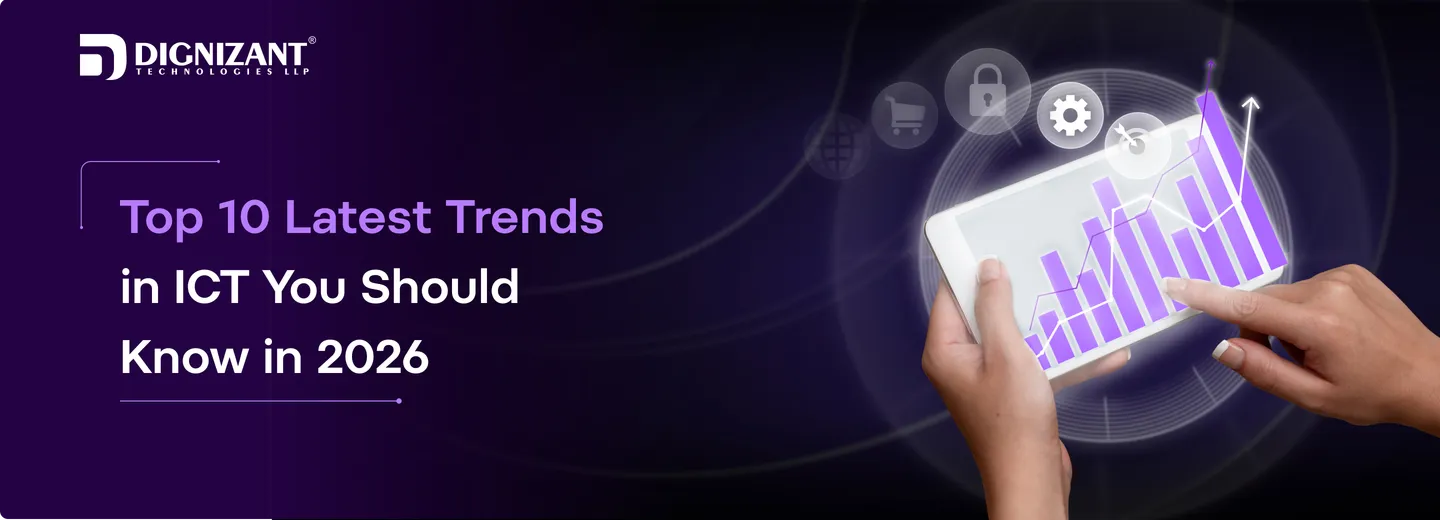
Top 10 Latest Trends in ICT You Should Know in 2026
Contributor
Palash Pandya
Uploaded
2 July, 2026
Read Time
8 Minutes
Views
374 views
Technology is evolving so fast, and many people just can’t keep up with the latest ICT Trends. New instruments, smart systems, cloud services, AI, improved security are revolutionizing business workflows. If you’re not aware of these changes you could be missing out on new opportunities, wasting time, or being left in the dust by your competitors.
In this blog, we are going to discuss the Top 10 Latest Trends in ICT that will shape 2026. We have described every trend in simple language so anyone can understand it. Learn how these new technologies enable businesses to grow, work better every day, reduce costs, and face the future with confidence.
10 Emerging Trends in Information Communication Technology
Information and communications technology (ICT) is evolving at a rapid pace. New devices give people the ability to work more efficiently, save time, and stay connected. Knowing these new trends will help businesses and individuals to predict changes in the future and to make smarter decisions for technology in the future.
What are the trends in ICT:
- Artificial Intelligence (AI) and Machine Learning
- Cloud Computing and Multi-Cloud Solutions
- Internet of Things (IoT)
- 5G and Next-Generation Connectivity
- Cybersecurity and Zero Trust Security
- Edge Computing
- Big Data and Advanced Analytics
- Blockchain Technology
- Automation and Robotic Process Automation (RPA)
- Green ICT and Sustainable Technology
1. Artificial Intelligence (AI) and Machine Learning
Artificial Intelligence (AI) and Machine Learning are dramatically changing the way people and businesses adopt technology. AI can learn from data, answer questions, automate routine tasks, and enable people to make better decisions. Machine Learning means that computers can learn over time, and do not need to be explicitly programmed each time.
Today, AI is being used by numerous companies in their customer service, data analysis, e-commerce, healthcare, and security. Because one of the largest ICT trends, AI and Machine Learning, allows businesses to save time, save money, provide greater precision, and offer better customer service.
2. Cloud Computing and Multi-Cloud Solutions
Cloud Computing allows people to store files, run applications and access data over the internet rather than on a single computer. This makes work easier since teams can share information regardless of where they are. Multi-Cloud Solutions are now in use by many businesses with those businesses using cloud services from multiple providers. This results in extra security, better performance and greater flexibility.
Cloud computing technology also accelerates business growth, significantly reduces IT costs, safeguards mission-critical data, and helps maintain mission-critical services, even when the systems running those services malfunction.
3. Internet of Things (IoT)
IoT is the network of physical devices that are connected to the internet so they can collect and share data. Smartphones, home security cameras, factory machines, and cars are all examples of IoT devices. These devices allow people to work efficiently, minimize errors and save time.
Today, Industrial IoT Applications are transforming the way factories and businesses monitor machinery, track equipment, manage production and minimize downtime. As the IoT technology is evolving, it is transforming industries to be smarter, safer, more efficient, and empowering businesses to make better decisions through real-time data.
4. 5G and Next-Generation Connectivity
5G is the new mobile network technology and it is significantly faster than the previous networks. It enables individuals to download files at a fast rate, have a smooth video call experience and connect a large number of smart devices all at once.
5G is good for businesses as well, perhaps more so, as it enables cloud services, smart factories, remote work and real-time communication. Next-generation connectivity adds a new dimension of speed, latency, and digital experience. With more countries rolling out 5G networks, it will be crucial to shape the future of Information and Communication Technology.
5. Cybersecurity and Zero Trust Security
Cybersecurity is a technology or practice that is designed to protect your computer, server, mobile device, electronic system, network, or data from malicious attacks. Organizations are under more attack now than at any other point in history so having robust security is extremely necessary. AI in Cybersecurity can help identify threats more rapidly, prevent attacks at an early stage, and safeguard critical information. Many firms also utilize Zero Trust Security, which verifies every user and device that requests permission. This is one of the biggest IT trends and technological enhancements that make companies secure.
As businesses beef up security budgets due to increasing cyber threats, smart security sales are booming. Strong passwords, multi-factor authentication, AI monitoring and Zero Trust Security help mitigate these risks, he said. These security procedures allow companies to shield the data of their customers, avoid financial damages caused by attacks, and gain the trust of users.
6. Edge Computing
Instead of routing all data back to a remote cloud server, Edge Computing processes data where it is generated. This results in faster device response and reduced latency. It is widely applied in smart factory, healthcare, autonomous driving, and IoT devices that require rapid decision making. Edge Computing is advancing to one of the top IT trends for its speed and performance enhancement.
Edge Computing helps businesses process real-time data with less internet traffic and lower operating costs. It's also a way to enhance security by storing sensitive information closer to the source. With the number of smart devices continuing to increase that connect to the internet, Edge Computing will remain a major player in today’s IT trends and technologies.
7. Big Data and Advanced Analytics
Big Data is the information that is gathered and the systems that are used to process that information. Advanced Analytics enables organizations to analyze such data to derive meaningful insights and make more informed business decisions. Web analytics services are also employed by many companies for the purposes of analyzing website visitors, correcting user experience, and growing a business. It is one of the most crucial ICT trends enabling organisations to work smarter.
Big Data is what allows organizations to collect, hold, and process vast amounts of information to showcase new value to customers and reflect on new strategies of work. Instead of just offering Best Practice guidance on what to do, they can use the data to provide Next Practice guidance on what to do now and in the future. As the amount of data being generated on a daily basis keeps increasing, technologies such as Big Data and Advanced Analytics will continue to dominate the future of technology.
8. Blockchain Technology
Blockchain is a digital ledger that is decentralized and distributed, allowing information to be stored in a way that’s difficult to change or hack. It assists in securing keeping records safe, clear and easy to verify. Many businesses now use Blockchain Application Development to build secure payment systems, supply chain solutions, healthcare platforms, and digital identity applications. It is one of the leading future ICT trends changing many industries.
Trust between business and customer is also affected by blockchains, as the latter records transactions in a secure manner. It streamlines identity, cuts down on fraud, provides greater transparency, and strengthens reliance on digital processes. With more industries using blockchain, it will be a key component of day-to-day business and digital transformation.
9. Automation and Robotic Process Automation (RPA)
Automation enables companies to perform daily functions with less manual effort. Robotic Process Automation (RPA) employs software bots to handle mundane and monotonous jobs such as entering data, generating reports and managing invoices. This results in time-saving, fewer errors and higher productivity. It is one of the most promising and beneficial ICT trends for today’s business world.
Many organizations are adopting RPA to accelerate workflows and leverage their human resources towards higher priority tasks. It also contributes to enhanced customer service, reduced costs and increased accuracy. As the technology continues to advance, Automation and RPA will have more significance in business success.
10. Green ICT and Sustainable Technology
Green ICT is that which utilizes technology to protect the environment. Green IT is a drive to get businesses to purchase more energy efficient equipment, to responsibly dispose of electronic waste and to reduce energy usage. These small actions can help companies save money as they minimize the effect they have on the environment. It is one of the latest ICT trends that contributes to making the world a greener place.
More organizations are now opting for sustainable technology to foster growth over time. Cloud computing, virtual meetings, energy-efficient data centers also contribute to a reduction in carbon footprints. Green ICT means businesses can increase efficiency while being kind to the environment.
How the Latest Trends in ICT Benefit Businesses
With the latest ICT technologies, businesses can conduct business more quickly, intelligently, and safely. They bring better day-to-day efficiencies, reduce wastage and enable organizations to offer superior services.
1. Enhance productivity
New ICT trends automate hundreds of daily tasks and allow workers to finish their work more quickly. This not only saves time and reduces errors but also helps the team dedicate more time to other business-critical jobs.
2. Reduce Costs
Modern ICT solutions bring costs down for businesses by increasing efficiency and minimizing manual work. Cloud services, automation, and intelligent software also enable companies to reduce infrastructure and operations expenses.
3. Enhance the Customer experience
These ICT technologies allow companies to deliver quicker resolutions and higher quality services. AI tools, chatbots and data insights provide enterprises a better understanding of their customer’s needs and enable them to deliver an enhanced experience.
4. Strengthen Data Security
Sophisticated security solutions defend critical business and customer information against cyber attacks. A robust cybersecurity protocol minimizes risk and cultivates customer trust.
5. Support Digital Transformation
Emerging ICT trends are enabling organizations to transition from legacy systems to digital-first solutions. This leads to improved company performance, more innovation, and better preparedness for growth.
Challenges of Adopting New ICT Trends
The current development trends in information and communication technology are so that they offered tremendous advantages but also new challenges. Enterprises require sound planning, a competent workforce and appropriate technology to make good use of these new solutions.
1. Risks to Data Security
Employing new technology could heighten the chance of cyberattacks, if adequate security is not in place. They need to secure their data with trusted systems, regular patching and solid security hygiene.
2. High initial investment
There is usually an upfront cost associated with ICT solutions for software, hardware and training staff. Although the cost may be high at first, the long-term benefits often make the investment worth it.
3. Skill Gaps
New technology required new knowledge and skills. Companies usually have to provide training to their staff, or recruit specialists to make best use of contemporary ICT applications.
4. Integration with existing systems
Older software and systems are already in place in many businesses. The integration of new ICT solutions with older systems may require time, planning and technical assistance to get everything working seamlessly.
Conclusion
The latest trends in ICT are changing the way businesses work, communicate, and grow. From AI and cloud computing to IoT, cybersecurity, and automation, these technologies help improve efficiency, reduce costs, and create better customer experiences. By understanding and adopting the right ICT trends, businesses can stay competitive, prepare for future changes, and achieve long-term success in the digital world.
Latest Article
What it actually takes to build a Next.js app: real cost bands, timelines, team setup, and when to hire an agency instead of building it yourself.
Hiring a Next.js development agency? See scope, timeline, real cost bands, and questions to ask before you sign a contract with anyone.

Learn how to build a Next.js project step by step, when to hire help, and realistic cost and time ranges for different project sizes.
FAQs
Ready to Take Your Business to the Next Level?
Unlock new opportunities with expert solutions designed to elevate your brand. From strategy to execution, we empower your business with the tools, technology and talent it needs to thrive in today’s digital world.