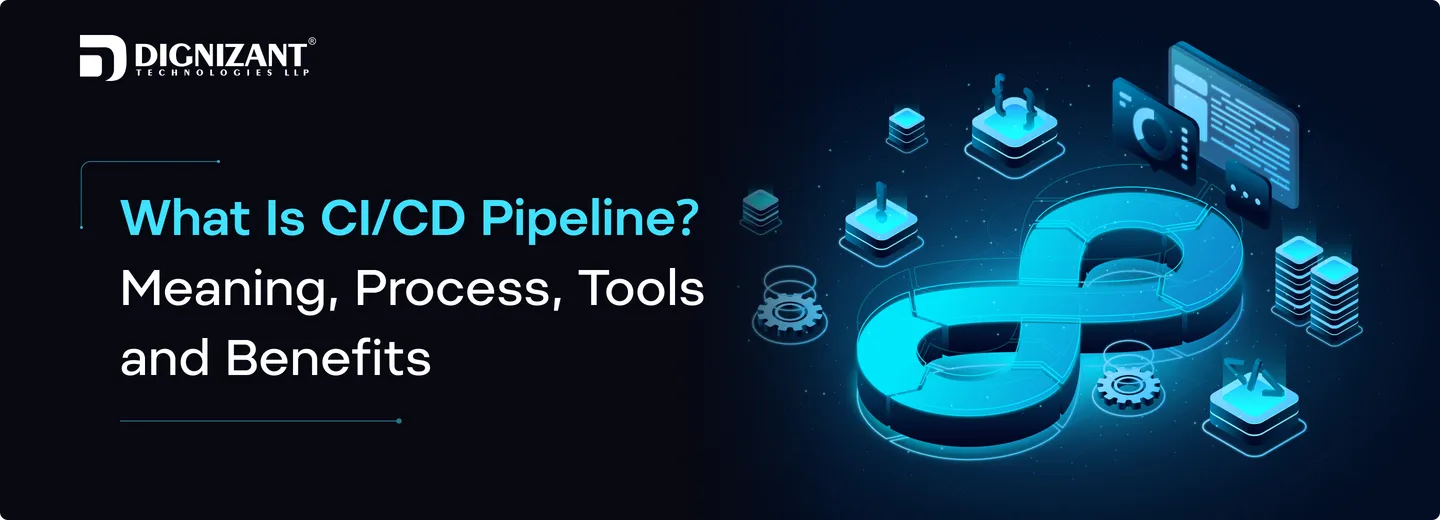
What Is CI/CD Pipeline? Meaning, Process, Tools and Benefits
Contributor
Vipul Kantharia
Uploaded
12 March, 2026
Read Time
10 Minutes
Views
75 views
This blog is an introduction to the CI/CD pipeline in modern software development. You will find out what it means, how it works, the tools developers use, and the advantages it offers teams. The guide covers every element and bits and pieces in simple terms so beginners can understand how CI/CD accelerates software build and delivery.
What is a CI CD Pipeline?
CI/CD pipeline is an intelligent and simple mode that enables developers to develop and ship software at a higher velocity. CI/CD stands for Continuous Integration – Continuous Delivery (or Continuous Deployment). In this case, developers submit their code work to the shared project multiple times each day. It then automatically reviews the code, tests it and ensures that everything is working as it should. It allows teams to identify issues sooner and maintain software stability.
A DevOps CI/CD pipeline also enables seamless transition for moving tested code from development to production applications. Once the code has passed all the tests, it can then be packaged and either automatically or manually released to users. This makes software updates quicker and safer, and also saves time and reduces human error. For this reason, many companies utilize CI/CD pipelines to deliver still more features and enhancements rapidly.
What are the Three Pillars of CI/CD
The CI/CD pipeline consists of pillars, which enable development teams to build, test, and fluidly release software. The pillars of CI CD full form is Continuous Integration and Continuous Delivery/Continuous Deployment, making the procedure automated, fast and reliable.
In the following, the three basic pillars of CI/CD are:
- Continuous Integration (CI)
- Continuous Delivery (CD)
- Continuous Deployment (CD)
What is Continuous Integration (CI)?
Continuous integration (CI) is a practice used by developers so that they can add their code to a shared project multiple times during the day. They set up an automatic check on new code to ensure everything is working well. The system builds the project and runs tests to detect errors fast. This allows developers to catch issues early on before the software becomes large.
The continuous integration pipeline is the sequence of steps that run automatically whenever code is added. It compiles the code, validates quality and executes tests that assure functionality of the software. Repeated at every code update, this process allows teams to work together easily and release superior software. It speeds up, secures, and organizes development.
What is Continuous Delivery (CD)?
Continuous Delivery (CD) establishes a system that allows developers to create software and release it to users through expedited processes. The system performs a second assessment of the code that has entered continuous integration to determine its operational readiness. The Continuous Delivery system requires your software to maintain a releasable state at all times, which enables you to launch products at your preferred times.
The continuous delivery pipeline serves as an automated system which processes checked-in code through multiple development stages until it achieves readiness for final release. It also performs additional tests, verifies the performance, and packages the application for release. Although there may still be a manual approval to the release before it goes to production. It enables teams to ship updates more rapidly, with less risk, and ensures that they are always delivering stable, high-quality software to users.
What is Continuous Deployment (CD)?
Continuous Deployment (CD) is a practice in which every change that passes all stages of your production pipeline is released to customers. In this process, developers commit code to the project and it is then checked, tested, and sent directly to the live application. As such, updates and new features can be shipped to users very quickly without needing manual approval.
A Continuous Deployment pipeline is the process that enables this automated workflow to take your code base from testing to production. It makes multiple checks to verify that the software is safe to use and working as expected before releasing it. With everything automated, teams can ship better features faster, make fewer human errors, and keep their applications constantly up-to-date.
The Relation Between DevOps and CI/CD
DevOps and CI/CD are a perfect match and enable teams to develop and deliver software more quickly. A DevOps engineer is a philosophy of working in which developers and operations personnel work closely together. The DevOps CI CD pipeline allows us to automate the process of building, testing and releasing code so we can roll out code changes quickly and safely.
In a CI CD DevOps environment, developers insert new code and the system auto-abortions, tests, and readies it for release. The CI CD pipeline process DevOps automates work (and encourages doing so), and allows the team to identify issues sooner. Due to this connection, DevOps and CI/CD best practices enhance software development and make it more seamless, efficient, and dependable.
How DevOps and CI/CD work together?:
- Automation: DevOps CI CD pipeline takes care of building, testing, and deployment.
- Faster delivery: CI/CD enables DevOps teams to deliver updates and features rapidly.
- Better collaboration: Developers and operations teams share tools and processes and collaborate.
- Improved Quality: With automated testing in the CI CD DevOps process, issues can be identified and addressed sooner.
Key Benefits of Using a CI/CD Pipeline
The CI/CD pipeline helps us to develop, test, and release software easily and quickly. It utilizes automation to enable developers to focus on writing better code as opposed to managing infrastructure, while the system takes care of several tasks in the background.
1. A quicker approach to software development and delivery
A CI/CD pipeline enables teams to move faster. As developers add code, it is automatically built and tested by the system. This means that teams don’t need to wait for time-consuming manual verifications. New features and updates can reach customers quickly. A faster delivery also allows a business to keep ahead of the competition, being able to update its products more frequently.
2. Early Bug Detection
Perhaps the greatest advantage of a CI/CD pipeline is that errors are detected early. The system triggers automatic testing procedures whenever developers introduce new code to the system. The developers receive immediate notification of any existing problems which enables them to resolve issues with high efficiency. The system prevents minor defects from escalating into major problems because of its design.
3. Better Team Collaboration
A CI/CD pipeline provides developers with seamless collaboration capabilities. Team members develop software together while the system automatically checks their combined work for compatibility with existing code. The team members can observe their progress because they follow a systematic process which helps them maintain safety throughout the project. The entire team experiences better development workflow because this system streamlines their work process.
4. Higher Software Quality
Quality gets better when you test often. In a CI/CD pipeline however, tests are run over and over again to verify that the software is working correctly. This kind of vigilance enables developers to set the bar much higher and reduces the possibility that a broken feature makes it into the hands of users. This makes the end product more dependable and stable.
5. Less Manual Work
In the absence of automation, developers have to do a variety of manual work such as building code, testing it, releasing it. These operations are managed by a CI/CD pipeline. It saves time, lets developers avoid human mistakes, and focuses on actual problems, rather than doing the same steps.
CI CD Pipeline Workflow
A CI CD pipeline workflow illustrates the sequential path that code takes from the moment the code is written the final is pushed for release. It enables teams to build, test and deliver software using automation and organization. Every stage validates the code so end-users are happy with the final product.
CI/CD Pipeline Workflow Steps:
Code Development
Contributors contribute new code or modify the existing features for a project. When they are done working, they commit their code to a shared repository for the rest of the team.
Code Integration
The new code is integrated into the main project code. This step verifies that the changes from various developers are compatible.
Automated Build Process
Once the code is integrated, the system builds the application automatically. This stage is when the source code is turned into a working program that can be run and tested.
Automated Testing
The pipeline executes several tests to see if the software is functioning properly. They enable bugs or errors to be identified rapidly so that these can be resolved at an early stage.
Staging Environment
The application is promoted to staging after passing tests. This environment is intended for the live system and enables teams to determine how the software behaves prior to going live.
Deployment to Production
After all works perfectly, system will release software to live environment where users can access it. This step can be automated or may require some kind of small approval.
What is CI CD Process in DevOps?
The DevOps pipeline consists of essential steps which enable teams to build their software and test it and deliver it without interruptions. The process conducts code verification which prepares the code for subsequent stages until the final product reaches operational status and users can access it.
1. Continuous Integration (Merging Code Frequently)
Continuous Integration, developers commit their code in a shared repository multiple times a day. The code is tested and built automatically on merging. This is to ensure the new changes integrate well with the old code. Developers can also detect and fix when an issue arises.
2. Continuous Testing
Continuous Testing is the practice of automating the testing of software in an integrated development environment, following integration. The system utilizes automated tests to confirm application accuracy while detecting any newly introduced errors that resulted from recent system changes. Developers can use these tests to find and fix software bugs before their work enters the next stage of development. Continuous testing improves software quality while reducing the chances of defects appearing in the final product.
3. Continuous Delivery
Continuous Delivery is the stage that prepares the tested application for release. She is finished and ready to be released depoyed now. The system bundles the application and delivers it to a staging space where teams can see it ahead of the final release.
4. Continuous Deployment
With Continuous Deployment, the application is delivered to the live environment automatically after passing all of these tests. At this point manual approval is bypassed. Because the new release is pushed immediately to the system, users can get new features and bug fixes immediately. This automation streamlines the process of companies getting enhancements out the door while helping to keep applications updated consistently.
5. Monitoring and Feedback
Monitoring and Feedback occur when the software is deployed. It monitors the system to make sure everything is running smoothly. They let administrators know if an issue, error or slow performance that can be measured in real time. Teams also receive user feedback on their application’s performance to collect metrics. The developers can use this information to make improvements as well as have better plans for future updates.
Most Common CI/CD Tools
Most teams currently implement CI/CD tools to automate their software development processes which include building, testing, and deploying software. The tools enable developers to deliver updates at a faster pace while reducing the development workload through automation.
1. Jenkins
Jenkins operates as the most widely used open source automation software tool that supports DevOps operations. The Jenkins CI/CD pipeline Pipe Wrench system allows developers to create application by building their code and executing tests within the Jenkins environment. Jenkins provides developers with endless options through its plugins which allow them to connect different tools and technologies used in their software development work.
2. GitLab CI/CD
GitLab CI/CD provides a built-in capability for the GitLab platform which helps to optimize development workflows. Developers create multiple stages which include build, test and deploy in a GitLab CI/CD pipeline example. Teams can access both code and pipelines because CI/CD exists as a repository component.
3. GitHub Actions
GitHub Actions serves as the most widely used automation tool for users of GitHub. Developers can create workflows which execute automatically whenever they push code changes to the system. Development teams can use GitHub CI/CD pipeline CI/CD pipelines to build their software and test it and release it through Automated CI/CD processes which make development easier for GitHub projects.
4. Azure DevOps Pipelines
The Azure DevOps Pipelines platform operates as a Microsoft cloud service which enables you to automatically execute code builds and testing processes on your project. The CI/CD pipeline system of Azure DevOps enables teams to build applications through multiple platforms by executing their code testing and deployment processes. The system integrates seamlessly with other Microsoft products and services.
5. AWS CodePipeline
Amazon AWS CodePipeline is a continuous integration and continuous delivery service that allows you to automate your release pipelines. It facilitates the transportation of code from development to the production environment via automated phases, including build, test and deploy. It is a good fit for use with other AWS services for cloud applications.
Best CI/CD Pipeline Examples
Organizations implement CI/CD pipelines to achieve efficient and secure software delivery. For example, a shopping website uses a cicd pipeline to implement new features, which include payment options and product filters. The system performs automatic code evaluation together with testing and release preparation when developers introduce new code.
Another example, the cicd pipeline automatically constructs and tests mobile banking applications whenever developers implement security enhancements or new features. The update becomes available to users after the successful execution of all system components. Companies utilize this method to achieve faster application delivery with improved quality and reduced operational mistakes.
Conclusion
Modern CI/CD pipelines enable software development teams to deliver products at faster rates because they automate the entire process of building, testing, and deploying code. The method eliminates the need for manual tasks while enhancing application performance, which enables businesses to execute updates with greater speed and safer methods. With the expansion of DevOps adoption today, organizations recognize CI/CD as a fundamental practice for conducting their software development work.
Dignizant Technology assists organizations in creating contemporary CI/CD systems that match their software development requirements. The team helps organizations develop efficient software delivery pipelines through their knowledge of DevOps methods and automation systems.
Latest Article
What it actually takes to build a Next.js app: real cost bands, timelines, team setup, and when to hire an agency instead of building it yourself.

Hiring a Next.js development agency? See scope, timeline, real cost bands, and questions to ask before you sign a contract with anyone.

Learn how to build a Next.js project step by step, when to hire help, and realistic cost and time ranges for different project sizes.
FAQs
Ready to Take Your Business to the Next Level?
Unlock new opportunities with expert solutions designed to elevate your brand. From strategy to execution, we empower your business with the tools, technology and talent it needs to thrive in today’s digital world.