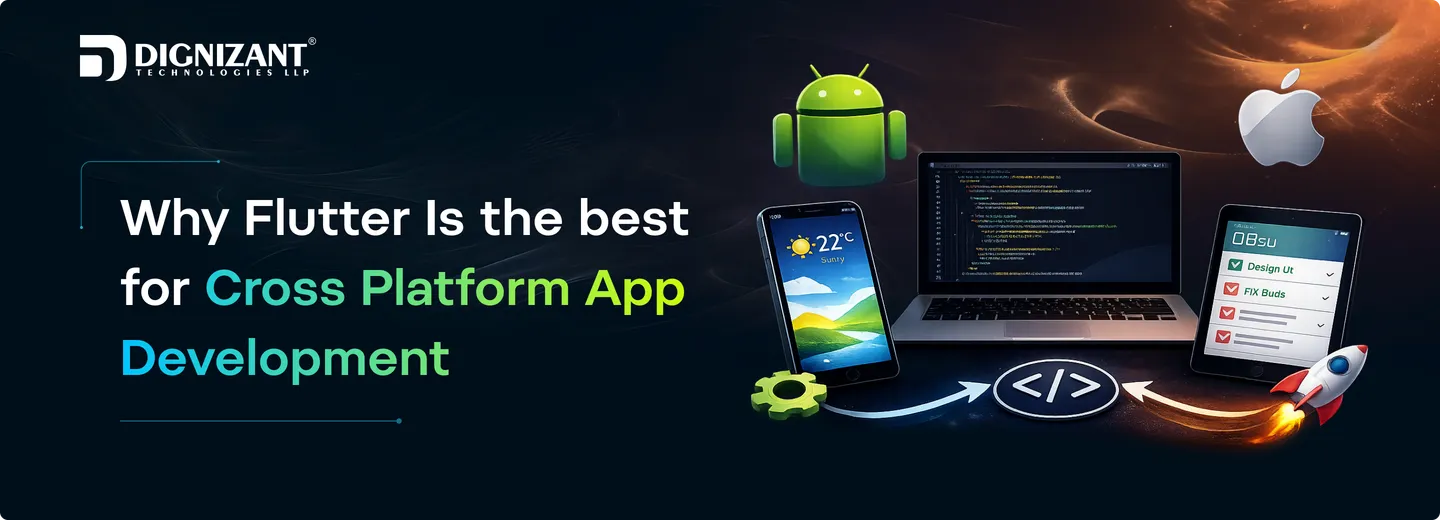
Why Flutter Is the best for Cross-Platform App Development
Contributor
Palash Pandya
Uploaded
17 February, 2026
Read Time
5 Minutes
Views
36 views
When mobile experiences shape brand perception in the marketplace, finding the right technology stack is not just a technology decision, but a strategic decision. In the current business environment, companies need speed, scale, performance and cost effectiveness. This is the reason that Flutter app development has become one of the leading cross-platform app development frameworks that too quickly.
Before we jump to declare Flutter as ‘the best’, let’s analyze it critically. Is it universally superior? Or is it smart as a business in certain business situations? Let’s examine this in depth.
Understanding Flutter and Its Architecture
Flutter is an open-source UI toolkit from Google. It enables developers to design apps for Android, iOS, the web and desktop with a single codebase.
Unlike other traditional hybrid frameworks that use WebViews and are neither fast nor performant, Flutter’s rendering engine is Skia and its performance is very high. This architectural distinction is critical. That means that, with Flutter, every pixel is drawn and it is not relying on native UI objects.
Why does this matter?
Because control over rendering equals:
- Consistent UI across platforms
- Better animation performance
- Reduced dependency conflicts
- Fewer device-specific inconsistencies
And now, from a technical perspective, this architecture goes a long way to solve the fragmentation problems in cross-platform development.
The Strategic Advantage of a Single Codebase
Cross-Platform Mobile App is the method of the day to eliminate repetition. Traditionally, companies built:
- One team for Android (Kotlin/Java)
- One team for iOS (Swift/Objective-C)
This doubled:
- Development cost
- Testing cycles
- Maintenance complexity
Flutter changes this equation.
With a single codebase:
- Feature rollouts are synchronized
- Bugs are fixed once
- Updates are deployed uniformly
However, the real value lies beyond cost savings. The strategic advantage is speed.
In competitive fields such as fintech, healthtech, SaaS or e-commerce, time-to-market can be the difference between a product’s life and death. Flutter speeds development time without reducing UI quality.
Performance: Myth vs Reality
One of the largest critiques of cross-platform frameworks in the past has been performance sacrifices.
Flutter challenges that narrative.
Building directly to native ARM code and utilizing the Dart language, Flutter applications run almost at par with their native counterparts. Smooth animations at 60fps (or 120fps where supported) are achievable.
But let’s challenge the assumption:
Does Flutter have the same performance as native?
Not entirely. In case of very hardware-intensive applications like high-end 3D games or heavy AR/VR environments, the native ones still could have a slight advantage.
But for 90% of business apps dashboards, marketplaces, booking services, fintech apps, SaaS tools and social media platforms, there is little to no perceivable difference in performance between Flutter and native.
From a strategic viewpoint, it provides the highest performance per investment.
Accelerated Development with Hot Reload
Hot Reload is one of Flutter’s killer features.
This allows developers to:
- Instantly see UI changes
- Test features in real-time
- Reduce debugging time
- Iterate rapidly
For startups, this equals faster MVP validation.
For businesses, that translates to faster feature testing.
The speed at which you iterate is frequently the key to your speed of innovation.
And velocity of innovation is what defines the difference between leaders and followers in mobile app development.
UI Flexibility and Brand Control
Flutter provides built-in support for:
- Material Design (Android styling)
- Cupertino widgets (iOS styling)
Most importantly, it provides a way to fully overhaul any UI.
This is particularly important for:
- Fintech apps requiring polished micro-interactions
- E-commerce apps demanding conversion-focused layouts
- SaaS dashboards that must display complex data
Unlike some cross-platform frameworks where the UI feels like it is “wrapped” and thus jarring, Flutter guarantees pixel-perfect precision.
For businesses focused on branding and differentiation, this is a major advantage.
Scalability for Growing Businesses
Tech decisions can't be only based on current state of need! The real question is:
Can you grow inside this structure?
Scalable architecture patterns are implemented in flutter like:-
- BLoC (Business Logic Component)
- Provider
- Riverpod
- Clean Architecture
This makes it suitable for:
- MVP launches
- Enterprise-grade platforms
- Multi-region app deployment
With expanding user base, 'performance and maintainability' becomes important. Structured architecture support for Flutter will reduce the amount of technical debt in the long run.
Cost Efficiency Beyond Initial Development
Most companies figure out development costs, but not lifetime costs.
Flutter reduces:
- Separate maintenance teams
- Platform-specific debugging
- Redundant testing processes
- Update deployment delays
Over a product lifecycle (3-5 years), these savings are even more pronounced.
From a practical business perspective, developing apps in Flutter is cost effective.
Strong Ecosystem and Community Support
A strategy without supporting the ecosystem is a risk.
Flutter benefits from:
- Continuous backing from Google
- Frequent updates
- Extensive documentation
- Growing plugin marketplace
- Large global developer community
This is an ecosystem which reduces risk of dependencies and provides long-term sustainability.
But, we do need to consider the reliability of the third-party plugin, before deciding on it to use. Blind inclusion of dependencies can lead to vulnerabilities.
The strength of the framework does not absolve from architectural responsibility.
When Flutter May Not Be Ideal
For the sake of integrity, Flutter is not a one-size-fits-all wonder.
Consider alternatives if:
- You need to use some very platform-specific features, not abstracted away at all
- You are developing graphically intense games applications
- You heavily rely on native, highly specialized, SDKs
In those scenarios, native solution is a better fit.
The key insight: Flutter is not a magic solution. It is a strategic accelerator when aligned with business goals.
Flutter in 2026: The Forward-Looking Perspective
Going forward cross-platform app development will gain traction due to the demands of businesses in:
- Faster digital transformation
- Multi-device compatibility
- Cost optimization
- Seamless user experience
As Flutter continues to grow on the web and desktop, it becomes an even more cohesive offering for building design of various screen densities.
The future is not base isolation of platforms. It is ecosystem convergence.
Flutter is a perfect fit for that direction.
Conclusion
So, if not Flutter then what is the best for cross-platform app development?
For most business applications yes.
It offers:
- High performance
- Faster time-to-market
- Reduced development cost
- Scalable architecture
- Stunning UI flexibility
- Strong ecosystem support
But the actual competitive advantage here is not just about picking a flutter, rather it’s about strategy to implement with architecture, clean code practices, optimized APIs and performance testing.
Technology is leverage. Strategy is power.
Latest Articles

What it actually takes to build a Next.js app: real cost bands, timelines, team setup, and when to hire an agency instead of building it yourself.

Hiring a Next.js development agency? See scope, timeline, real cost bands, and questions to ask before you sign a contract with anyone.

Learn how to build a Next.js project step by step, when to hire help, and realistic cost and time ranges for different project sizes.
FAQs
Ready to Take Your Business to the Next Level?
Unlock new opportunities with expert solutions designed to elevate your brand. From strategy to execution, we empower your business with the tools, technology and talent it needs to thrive in today’s digital world.