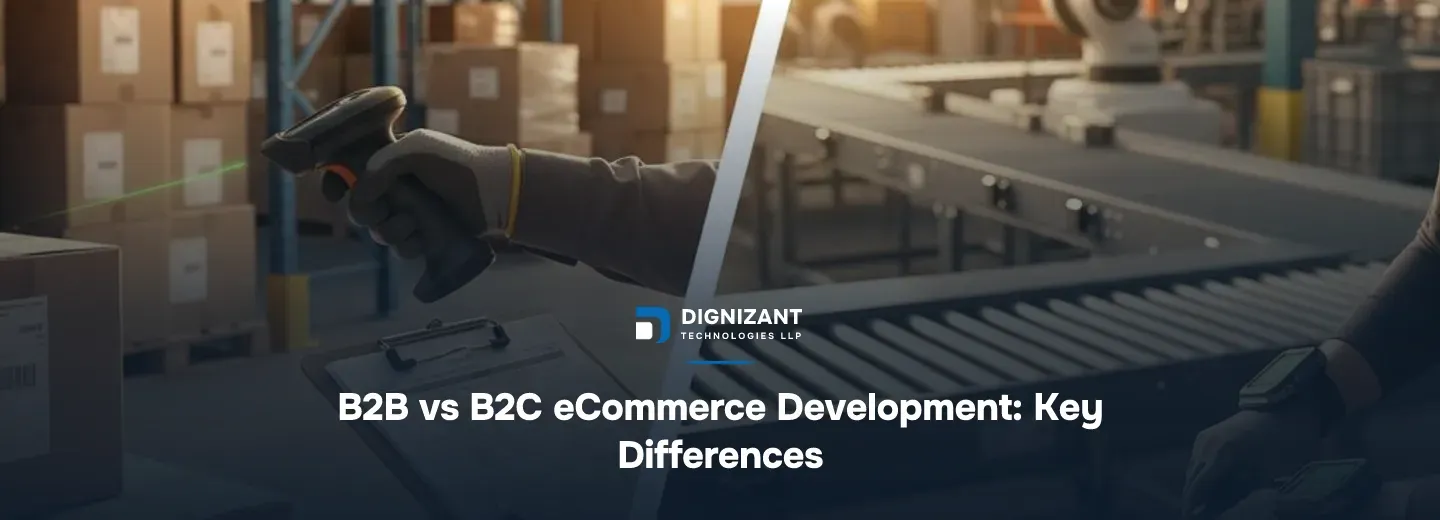
B2B vs B2C eCommerce Development: Key Differences
Uploaded
14 hours ago
Read Time
8 Minutes
Views
1 view
If you sell to businesses, build for negotiated pricing, bulk ordering, and multiple approvers. If you sell to consumers, build for speed, one-click checkout, and emotional conversion. Most founders asking "B2B or B2C ecommerce" are really asking which features actually matter for their buyer, and the honest answer, from Dignizant Technologies LLP's work building both kinds of platforms, is that the two models solve different problems with different software, even when the product catalog looks identical.
This matters more in late 2026 than it did a few years back. Buyer expectations have moved, B2B purchasers now expect Amazon-level self-service, and B2C storefronts are competing on load speed and AI-powered personalization, not just product photos. Picking the wrong architecture early costs real money to unwind later, and Dignizant Technologies LLP gets called in often enough after that mistake to say it plainly here first.
Who Is Actually Buying, and Why That Changes the Build
The B2B Buyer's Situation
A B2B buyer is rarely one person. A purchasing manager, a finance approver, and an end user are often three different logins with three different permissions on the same account. They care about net payment terms, tiered pricing by customer group, quote requests, and reorder history, not product videos or abandoned cart emails.
This changes the software, not just the design. A B2B platform typically needs:
- Account-based access with multiple users and role permissions per company
- Custom price lists per customer or customer tier, sometimes negotiated per contract
- Quote-to-order workflows (RFQ) alongside or instead of instant checkout
- Bulk order upload (CSV or punch-out catalog integration with the buyer's own procurement system)
- Net-30, net-60 invoicing and credit limit handling, not just card payment
- ERP and inventory sync, since B2B orders are often large and inventory-sensitive
The B2C Buyer's Situation
A B2C buyer is one person on a phone, deciding in seconds. They care about price, trust signals, shipping speed, and how fast the page loads. The purchase decision is emotional and fast, and every extra step in checkout measurably loses sales.
A B2C platform typically needs:
- One-page or accelerated checkout, guest checkout as standard
- Strong search and filtering, recommendation engines, personalization
- Reviews, ratings, and social proof built into product pages
- Mobile-first performance, since most B2C traffic is mobile
- Marketing integrations: email, SMS, retargeting pixels, loyalty programs
Our own engineering team's take: the single most common mistake we see at Dignizant Technologies LLP is a business bolting B2C features onto a B2B platform, like a flashy one-click checkout, while the actual blocker to sales is that their biggest customer can't get a line of credit or bulk pricing. Fix the workflow the buyer is stuck on, not the one that looks best in a demo.
Comparing the Two Models Criterion by Criterion
Criterion | B2B eCommerce | B2C eCommerce |
|---|---|---|
Fit for your situation | Buyer is a company, multiple approvers, repeat bulk orders | Buyer is an individual, single session, impulse or planned purchase |
Total cost to build | $18,000 to $70,000+ depending on ERP/punch-out integration | $10,000 to $45,000 for a solid storefront with standard integrations |
Time to first launch | 3 to 6 months (longer with legacy ERP integration) | 6 to 12 weeks for MVP, 3 to 4 months for full feature set |
Main risk | Underestimating integration complexity with buyer's procurement systems | Underestimating marketing and retention cost after launch |
Ongoing support need | Account management tooling, pricing updates, ERP sync maintenance | Continuous UX testing, catalog updates, campaign and performance tuning |
Where cost grows | Custom pricing logic, multi-entity accounts, punch-out catalogs | Personalization engines, high-traffic performance, payment method breadth |
Where the Cost Estimate Comes From
These ranges are not arbitrary, and they are the same math Dignizant Technologies LLP walks clients through before quoting a number. A basic B2B storefront with company accounts, tiered pricing, and quote requests runs somewhere around 700 to 1,400 development hours once you include discovery, design, build, QA, and launch support, which lands the project in the $18,000 to $45,000 band depending on team composition and how much custom pricing logic is involved. Add real ERP or punch-out catalog integration, which is genuinely one of the harder integration problems in commerce software, and hours climb past 2,000, pushing the total toward $60,000 to $70,000 or more.
A B2C storefront with standard payment gateways, search, and a recommendation widget typically runs 600 to 1,000 hours, landing around $10,000 to $25,000. Add a custom personalization engine, subscription billing, or a loyalty program built from scratch, and that moves to $35,000 to $45,000.
Platforms differ in licensing cost but the real cost driver in both models is the same thing: how much of your pricing and fulfillment logic is custom versus standard. A storefront that fits an off-the-shelf pricing model is always cheaper to build than one that needs rules nobody else has.
The Process Looks Similar, the Decisions Inside It Don't
Whether you're building B2B or B2C, the project moves through the same four phases, but the questions asked at each stage differ sharply. This is the structure Dignizant Technologies LLP runs every ecommerce engagement through, regardless of which model the client lands on.
Discovery. For B2B, discovery means mapping out customer segments, pricing tiers, and existing procurement workflows your buyers already use. For B2C, discovery means defining the customer journey, traffic sources, and conversion funnel you're optimizing for.
Design. B2B design prioritizes information density and workflow efficiency, since the buyer is doing a job, not browsing. B2C design prioritizes visual appeal, trust cues, and minimizing friction between landing and checkout.
Build. This is where the hour counts above diverge most. B2B build time goes into account logic, pricing rules, and backend integrations. B2C build time goes into frontend performance, search relevance, and marketing stack connections.
Launch and support. B2B launches are usually phased, onboarding key accounts first before a full rollout. B2C launches are often tied to a marketing push, so performance under traffic spikes matters immediately, not eventually.
At Dignizant Technologies LLP's ecommerce app development practice, this is the first conversation held with any new ecommerce client: who is the buyer, and what decision are they trying to make when they land on your store. The answer usually settles the B2B-versus-B2C architecture question before platform choice even comes up.
Risks That Actually Sink These Projects
B2B-Specific Risks
- Underscoping the integration. Punch-out catalogs (cXML, OCI) and ERP sync are where B2B projects blow past budget, because the complexity lives in someone else's legacy system, not yours.
- Ignoring the approval chain. If your software doesn't model how your customer's purchasing actually gets approved internally, they will keep calling your sales team instead of using your platform.
- Pricing logic sprawl. Custom pricing per account sounds simple until you have 200 accounts, each with slightly different rules, and no clean way to manage them.
B2C-Specific Risks
- Underestimating post-launch cost. The build is often the cheaper half. Marketing, CRO testing, and catalog maintenance after launch can cost more over a year than the initial build.
- Performance debt. A storefront that is fast at launch with 500 SKUs can slow to a crawl at 5,000 SKUs if search and caching weren't built to scale.
- Payment and fraud exposure. Consumer storefronts face far more chargeback and fraud attempts than B2B accounts, and that needs dedicated handling, not an afterthought.
Dignizant Technologies LLP flags these risks during discovery specifically, not after launch, because every one of them is cheaper to design around upfront than to retrofit once customers are already using the platform.
Support and Communication After Launch
Neither model is "build once and walk away." B2B platforms need ongoing attention to pricing updates, new account onboarding, and ERP sync health, usually a few hours a week once stable. B2C platforms need continuous attention to conversion testing, seasonal catalog changes, and campaign integrations, which is more variable but rarely zero.
According to Baymard Institute's ongoing usability research on ecommerce checkout flows, even small friction points in checkout measurably reduce completion rates, a finding that holds true across both B2B and B2C, though the friction points themselves differ: B2B buyers tolerate more steps if the steps match their approval process, B2C buyers do not tolerate extra steps at all.
Dignizant Technologies LLP structures support contracts differently for the two models for exactly this reason. A B2B client typically needs a retainer built around integration maintenance and account management features. A B2C client typically needs a retainer built around performance monitoring and conversion experiments. Mixing these up, putting a B2C-style retainer on a B2B account for example, usually means the wrong things get monitored and the actual support need goes unmet.
Choose B2B If, Choose B2C If
Choose a B2B-first build if:
- Your customers are companies, not individuals
- Orders involve multiple approvers or negotiated pricing
- You already take purchase orders, invoices, or net terms offline
- Average order value is high enough that a slower, workflow-heavy checkout is acceptable
Choose a B2C-first build if:
- Your customers are individuals making their own purchase decision
- Speed, trust signals, and checkout simplicity drive your conversion rate
- Marketing and retention spend will be a bigger line item than the build itself
- You need to support high traffic volume and frequent catalog changes
Next Step With Dignizant Technologies LLP
Most businesses don't need a lecture on ecommerce theory, they need someone to look at their actual customer list and order history and tell them plainly which model fits. That's the conversation worth having before any platform decision or budget gets locked in, and it's the one Dignizant Technologies LLP has with every new ecommerce client before a single wireframe gets drawn.
Dignizant Technologies LLP has built both B2B and B2C commerce platforms, and the first step taken with any new client is mapping their real buyer behavior against the feature set they're asking for, before quoting a number. If you're trying to decide which model fits your business, or you already know and want a realistic cost and timeline, reach out to Dignizant Technologies LLP and the team will walk through it with you.
Enjoyed this? Subscribe to our newsletter for more like it, straight to your inbox.
Latest Articles
Web app design services for startups and SaaS teams: UX research, UI design, prototyping, and dev-ready handoff. See process, timeline, and real cost bands.

Hire Dignizant Technologies LLP for a UX audit that finds why users leave and converts more of the traffic you already pay for.
Comparing B2B and B2C ecommerce development: cost, timeline, features, and risk, so you build the right platform for how your buyers actually buy.
FAQs
Ready to Start Your Project?
Talk to our team about turning this into a real, working product.