React Native Development Agency: How to Choose One
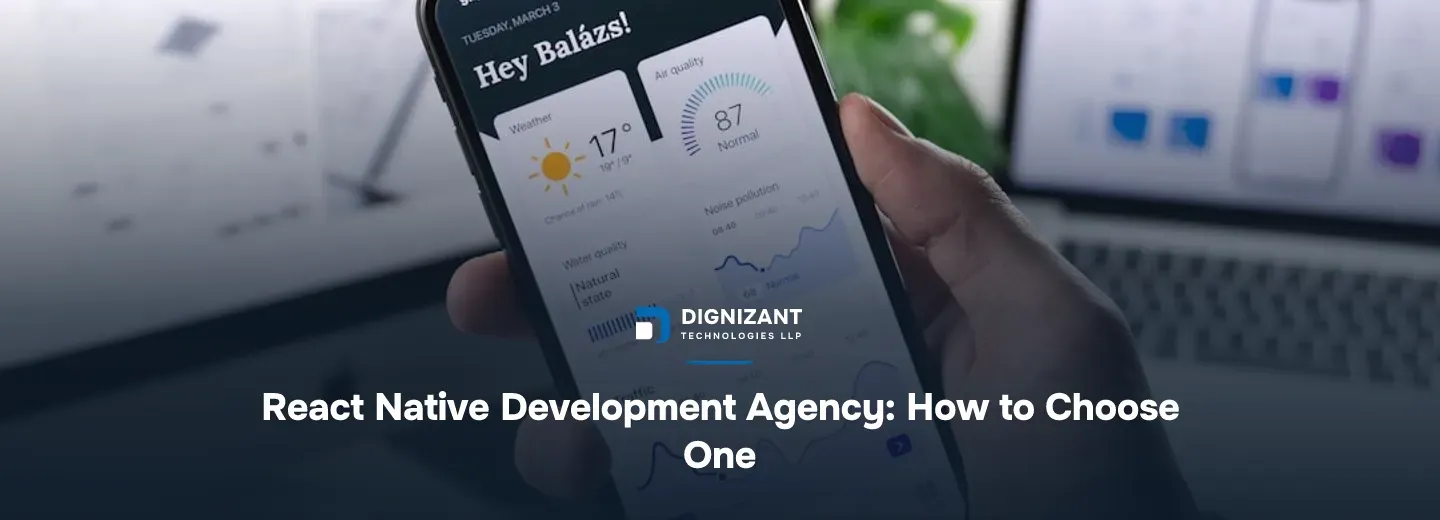
Photo by Balázs Kétyi on Unsplash
Uploaded
29 August, 2026
Read Time
8 Minutes
Views
21 views
What a React Native Development Agency Actually Does
A React Native development agency builds mobile apps for iOS and Android from a single JavaScript or TypeScript codebase, using React Native as the framework that renders real native components instead of a web view wrapped in a shell. The pitch is simple: write the app once, ship it on both platforms, and avoid maintaining two separate native teams. The execution is where agencies differ wildly.
Most agencies selling "React Native development" are really selling three different things depending on your project: a cross-platform rebuild of an existing native app, a brand-new app built cross-platform from day one, or ongoing feature work and maintenance on an app someone else started. Each of these needs a different kind of team, and the pricing conversation should reflect that difference rather than treating all React Native work as one flat service.
If you are trying to decide between hiring a full agency, a freelance developer, or building an in-house team, our other pieces go deeper on that decision. See Hire React Native Developer: Costs, Vetting, Hiring Models and Hire React Native Developers: Costs, Vetting, Timelines for the hiring-model breakdown. This piece focuses specifically on what to look for when the option you're evaluating is an agency.
Why Companies Pick an Agency Over a Freelancer or In-House Hire
An agency gives you a team, not a person. That matters more in React Native than in most other stacks because a real production app needs several distinct skill sets working together: a React Native engineer who understands the JavaScript bridge and native modules, someone who can write or review native iOS and Android code when a library doesn't cover your use case, a QA person who tests on real devices rather than just simulators, and a project lead who keeps the release calendar on track across both app stores.
A single freelancer can be excellent at the React Native layer and still get stuck for a week on a native module conflict that a team with in-house iOS and Android experience would resolve in a day. That single point of failure is the real risk with solo hires, not skill level.
The trade-off is cost and communication overhead. A freelancer bills fewer total hours because there's no coordination layer, and you deal with one person directly. An agency adds project management, QA cycles, and often a slightly higher blended rate, but it also removes the risk of a single person going unavailable mid-project.
Our own engineering team's take: the projects that go over budget almost never fail because of the React Native code itself. They fail because nobody planned for the native module work, the app store review cycle, or the device testing matrix until it was already late in the project.
What Realistic Cost Ranges Actually Look Like
Cost bands in React Native development vary by scope more than almost anything else, so treat any single number you see quoted with suspicion until you know what's actually included.
A simple app, meaning 5 to 8 screens, basic navigation, one or two third-party integrations like a payment processor or a maps SDK, and no custom native modules, typically takes 250 to 400 development hours when you include design handoff, QA, and app store submission. At a blended hourly rate grounded in $10 to $15 per hour for offshore development talent, that works out to roughly $2,500 to $6,000 for the build itself, before ongoing maintenance.
A mid-complexity app, the kind with user accounts, push notifications, offline data sync, a moderate number of screens (15 to 25), and at least one custom native integration, usually runs 500 to 900 hours. That lands in the $5,000 to $13,500 range using the same hourly basis.
A complex app, things like on-demand marketplace platforms, apps with real-time video or audio, heavy background processing, or apps that need to pass strict compliance review (healthcare, finance), can run 1,200 to 2,500+ hours. That puts total cost anywhere from $12,000 to $37,500 or more, and projects at this end often extend past 6 months.
App Complexity | Typical Hours | Rough Cost Range | Typical Timeline |
|---|---|---|---|
Simple (5-8 screens, 1-2 integrations) | 250-400 | $2,500 - $6,000 | 6-10 weeks |
Mid-complexity (accounts, push, offline sync) | 500-900 | $5,000 - $13,500 | 3-5 months |
Complex (marketplace, real-time, compliance) | 1,200-2,500+ | $12,000 - $37,500+ | 6-12+ months |
These ranges assume offshore or globally distributed development talent billed in that $10 to $15 per hour band as the underlying cost basis, not a rate any single agency will quote you directly. Agencies price projects differently depending on their overhead, project management structure, and whether they fix-bid or bill hourly, so use these numbers as a sanity check against quotes rather than a rate card.
Signs of a Strong Agency Versus a Weak One
Not every agency claiming React Native expertise has actually shipped a production app through both app stores. Here's what separates the two.
Strong agencies:
- Show you actual apps they built, not just Figma mockups or web portfolio pieces relabeled as mobile work
- Can name the native modules or libraries they'd use for your specific feature set before you sign anything
- Have a QA process that includes real physical devices, not just iOS Simulator and Android emulator
- Talk about app store review timelines and rejection risk without you bringing it up first
- Give you a clear maintenance and update plan for when Apple or Google changes platform requirements
Weak agencies:
- Quote a single flat price without asking about your integrations, offline requirements, or expected user load
- Can't explain the difference between the old React Native architecture and the current one
- Treat app store submission as an afterthought rather than a planned milestone with buffer time
- Have no answer for what happens when a third-party library breaks after a React Native version upgrade
- Push you toward Expo or bare React Native without explaining the trade-off for your specific app
Expo Managed Workflow Versus Bare React Native
This decision affects both cost and long-term flexibility, and a good agency should walk you through it rather than pick it for you silently.
Expo's managed workflow has matured significantly and now supports most native module needs through its config plugin system, documented directly on the Expo documentation site. For most business apps, cameras, push notifications, in-app purchases, biometric login, Expo covers it without ejecting to bare workflow.
Bare React Native gives you full control over native code, which matters if you need a highly specific SDK integration, custom native performance work, or you're bringing over legacy native modules from an existing app. It also means your team owns more of the native build configuration directly, which adds maintenance overhead but removes dependency on Expo's release cycle for critical fixes.
The honest guidance: if your app is a fairly standard business, e-commerce, or content app, Expo managed workflow will very likely save you build time and reduce long-term maintenance cost. If you're building something with unusual hardware requirements, heavy background processing, or you're migrating an existing native codebase gradually, bare workflow is usually the right call even though it costs more upfront in setup time.
Questions to Ask Before You Sign a Contract
A short, specific list here saves you from discovering problems three months into a project.
- How many production apps has this exact team (not the agency overall) shipped to both app stores?
- What's the plan if a third-party library breaks on a React Native version upgrade mid-project?
- Who handles native iOS and Android code when a feature needs it, and is that person on this project or borrowed from elsewhere?
- What does the QA process look like, and on how many real physical devices?
- Is app store submission and review time built into the project timeline, or treated as a separate step after "completion"?
- What's included in post-launch maintenance, and what's billed separately?
If an agency can't answer questions 1 through 3 clearly and specifically, that's a real warning sign worth taking seriously.
How React Native Compares to Other Cross-Platform and Native Options
React Native isn't the only path to a mobile app, and a competent agency should be honest about when it's not the right fit rather than defaulting to it because it's their specialty.
Flutter is a real competitor, particularly for apps with heavy custom UI or animation, since it renders its own UI layer rather than bridging to native components. Native development (Swift for iOS, Kotlin for Android) remains the right call for apps that need maximum performance, deep OS-level integration, or are built by teams with existing native codebases they don't want to abandon.
React Native's real advantage is the size of its ecosystem and the overlap with web development skills. A team that already knows React for web can pick up React Native meaningfully faster than learning Flutter's Dart language or native Swift and Kotlin from scratch, which shortens hiring time and often lowers long-term maintenance cost.
According to the State of JS survey, React remains one of the most widely used and retained frameworks among JavaScript developers, which matters practically because it means a larger hiring pool for React Native talent specifically compared to less common cross-platform frameworks.
Where Web Development Fits Into the Picture
Many companies hiring a React Native agency also need a companion web presence, whether that's a marketing site, an admin dashboard for the app, or a full web app that shares business logic with the mobile version. If your React Native app needs a web counterpart, it's worth asking your agency directly whether they handle web development in-house or whether you'll be coordinating two separate vendors.
Coordinating two vendors isn't wrong, but it adds real communication overhead, especially when the mobile and web teams need to agree on shared APIs, data models, or design systems. An agency that can handle both under one roof, or at least one point of contact, tends to move faster on projects where mobile and web need to stay in sync.
Working With Dignizant
Choosing a React Native development agency comes down to verifying real shipped work, understanding the actual cost drivers behind your specific app's complexity, and getting straight answers about native module handling, QA process, and app store timelines before you sign anything. The cost ranges above should give you a working sense of what a fair quote looks like for your project's actual scope, not just its label.
Dignizant builds and maintains React Native apps across the complexity spectrum described here, from simple single-purpose apps to multi-integration platforms, and can also handle the companion web work many mobile projects end up needing. If you're evaluating agencies for an upcoming React Native project, reach out to Dignizant with your app's scope and we'll walk you through what a realistic timeline and cost range looks like for it specifically.
Enjoyed this? Subscribe to our newsletter for more like it, straight to your inbox.
Latest Articles

Planning custom content management system development? See real costs, timelines, build vs buy trade-offs, and how Dignizant's process works.

Looking for a reactjs developer for hire? See what's included, how the engagement runs, real cost bands, and the questions to ask before you sign.
A plain guide to custom web portal development: what it costs, how long it takes, and how to decide between a portal and an off-the-shelf tool.
FAQs
Ready to Start Your Project?
Talk to our team about turning this into a real, working product.